

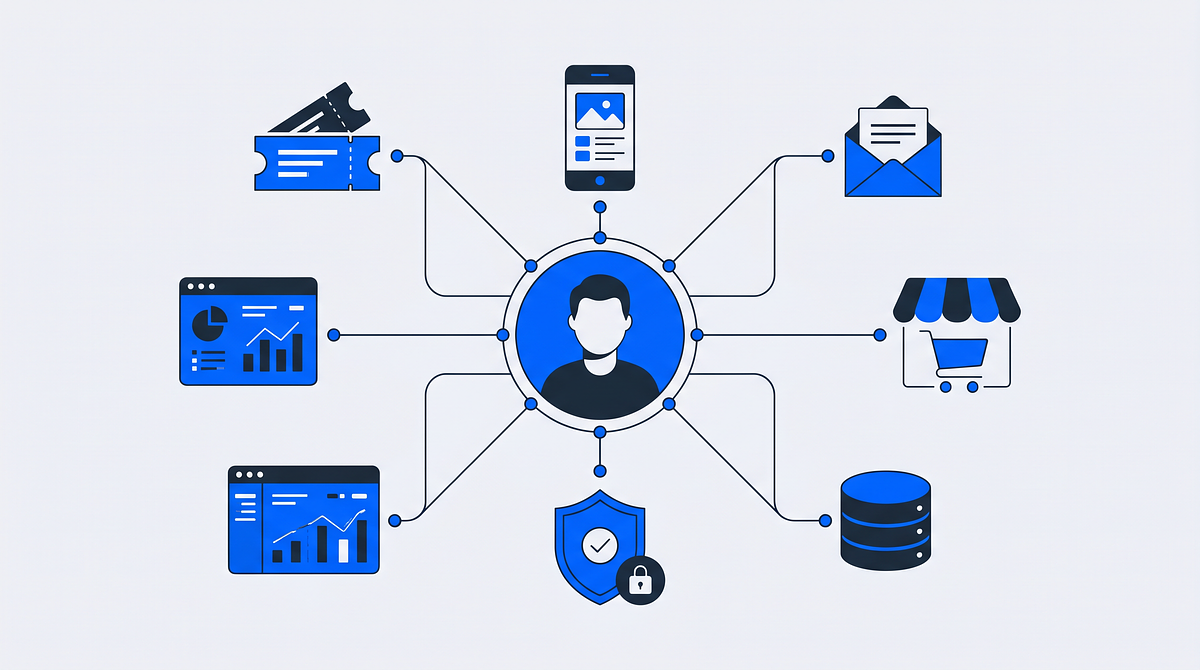
Most sports organizations and media brands know more about their fans than they realize. The problem is that this knowledge lives across five different systems that never speak to each other.
A 360-degree fan profile solves that problem by connecting every part of fan data, from ticket purchases and app activity to newsletter preferences, to a single identity. This guide explains what belongs in that profile, which systems should be connected, and how to build it step by step with single sign-on and a central identity layer.
What is a 360-degree fan profile?
A 360-degree fan profile is a single, unified record that brings together everything an organization knows about a fan. Instead of keeping ticket purchases in one system, app activity in another, and email preferences somewhere else, the 360-degree profile links all of that information to one central identity.
The “360-degree” part refers to how complete the view is, not to rotation or angle. Think of it like puzzle pieces scattered across different boxes: your ticketing platform holds some, your merchandise shop holds others, and your CRM stores a few more. A 360-degree profile puts those pieces together into one complete picture.
Here’s what a typical 360-degree fan profile includes:
- Identity data: name, email, phone number, login credentials, unique fan ID
- Engagement data: articles read, videos watched, app sessions, event check-ins
- Transactional data: ticket purchases, merchandise orders, membership history, lifetime value
- Consent data: GDPR opt-ins, communication preferences, declared interests
The unique fan ID is the anchor. Without it, matching a ticket purchase to an app download and a newsletter signup becomes guesswork.
Why a unified fan profile matters for sports organizations and media brands
When fan data lives in separate systems, something 80% of organizations struggle with, each department sees only one slice of who that fan really is. The ticketing team knows attendance patterns. The e-commerce team knows purchase history. The marketing team knows email engagement. But no one sees the full picture.
That fragmentation creates real problems. A fan who attended three matches last season but never bought merchandise may be an ideal candidate for a targeted jersey offer. Without a unified profile, that opportunity stays invisible.
The commercial outcomes of unification are direct:
- Targeted campaigns: marketing teams can segment based on actual behavior instead of broad assumptions
- Membership upgrades: teams can identify fans who are ready for premium tiers based on engagement patterns
- Accurate lifetime value: finance teams can calculate what a fan is really worth across all touchpoints
- GDPR clarity: consent records sit in one place instead of being scattered across systems
For heads of digital and managing directors, the business case is simple: decisions based on incomplete data lead to missed revenue and compliance risk, with GDPR fines exceeding €7.1 billion since 2018.
Core data points in a 360-degree fan profile
Identity and account data
Every unified profile starts with identity data. That includes the fan’s name, email address, phone number, and the login method they use, whether that’s email and password, social login, or something else.
The central fan ID is the most important element here. This unique identifier acts as the anchor that connects all other data together. Without a consistent fan ID, you cannot reliably connect a ticket purchase with an app download and a newsletter signup.
Behavioral and engagement data
Behavioral data shows what fans actually do. That includes articles read, videos watched, how often they open your app, which push notifications they respond to, and which events they attend.
A fan who watches every match replay but has never bought a ticket looks very different from someone who regularly attends home games but ignores digital content. Behavioral data makes that difference visible.
Transaction and membership data
Transactional data covers purchases: tickets, merchandise, subscriptions, and donations. It also includes membership tier, renewal dates, and lifetime value metrics.
This data is often the most commercially valuable, yet it frequently lives in isolated systems that do not share information with marketing tools.
Consent and preference data
Consent data captures what fans have agreed to: marketing emails, push notifications, partner offers, and data processing for personalization. Preference data captures what fans have actively told you, such as their favorite team, preferred language, or preferred communication channel.
Information fans intentionally share is sometimes called zero-party data. Unlike behavioral data, which you observe, zero-party data is knowingly provided by the fan.
Fan data sources that should be connected into a single view
Ticketing and event platforms
Ticketing systems hold attendance history, seat preferences, and purchase patterns. Connecting this data brings matchday behavior into the profile and shows which fans regularly attend and which ones have dropped off.
E-commerce and merchandise shops
Online stores hold transaction history, product preferences, and cart abandonment data. Connecting them enables purchase-based segmentation, such as identifying fans who buy a new jersey every season versus those who have never made a purchase.
Apps, streaming, and content platforms
Mobile apps and streaming services capture engagement data: session frequency, content consumption, and push notification responses. Since 39% of fans aged 18 to 29 now consume more sports content year over year, this data often reveals fan interests that transaction data alone cannot show.
CRM, CDP, and marketing tools
Many organizations already store partial fan data in a CRM system or customer data platform. The goal is not to replace those systems, but to sync and enrich them with a unified identity layer.
| Data source | Example data captured |
|---|---|
| Ticketing platform | Match attendance, seat location, purchase dates |
| E-commerce shop | Merchandise purchases, cart abandonment |
| Mobile app | Session frequency, content viewed, push responses |
| CRM/CDP | Contact records, campaign history, segments |
How to build a 360-degree fan profile step by step
Step 1: Audit existing fan data silos
Start by identifying every system that contains fan data. Document what data each one holds and how fans are identified inside it, whether by email, account ID, or something else.
This audit reveals duplicates, gaps, and inconsistencies. You may discover that the same fan exists as three separate records across three systems with slightly different information.
Step 2: Define a central fan ID and data model
Choose a unique identifier that links all fan records across systems. Then define the data fields that matter most to your organization and map how they appear in each source system.
The fan ID becomes the common thread. Every system references that ID when sending or receiving data.
Step 3: Implement single sign-on across all touchpoints
Single sign-on (SSO) allows fans to use one login across your website, app, shop, and ticketing experience. SSO creates the identity layer that links all interactions to one profile.
The technical standards that enable secure SSO are OpenID Connect (OIDC) and Security Assertion Markup Language (SAML). Both are widely supported and make it possible to integrate with enterprise systems and third-party services.
Step 4: Migrate and match existing fan records
Import historical data from legacy systems and use matching rules such as email address or phone number to merge duplicate records into unified profiles.
Data migration is often the most time-consuming step. A fan may have signed up for tickets with a personal email and for a newsletter with a work address. Matching rules help identify and merge those duplicates.
Step 5: Configure consent and preference capture
Set up GDPR-compliant consent screens during registration and login. Add preference and zero-party data capture through profile settings where fans can declare their interests.
Consent captured at one touchpoint does not automatically apply to another. A fan who opted into email marketing has not necessarily agreed to push notifications as well.
Step 6: Sync data with connected systems
Use APIs and webhooks to keep fan data synchronized between the identity layer and downstream systems such as CRM, CDP, and marketing automation.
Continuous syncing keeps profiles current. Batch imports, by contrast, create stale data and missed opportunities.
Step 7: Activate the profile for campaigns and memberships
Once profiles are unified, you can run ID-based campaigns for known fans and manage premium memberships from one system. A fan’s engagement history, purchase patterns, and preferences then become available for segmentation and personalization.
Choosing the right identity and data architecture for fan profiles
Identity layer with OpenID Connect and SAML
OpenID Connect and SAML are industry standards for secure authentication. Supporting these standards makes it possible to integrate with enterprise systems and third-party services without custom development for every connection.
When evaluating identity solutions, look for native support for both protocols. That ensures compatibility with the widest range of systems.
Consent layer with zero-party data capture
The consent layer stores GDPR-compliant permissions and supports zero-party data collection. Look for solutions with a self-service preference center where fans can view and manage their own data.
A branded preference center where fans control their own information improves both trust and data quality.
Integration layer with APIs and webhooks
Strong APIs and webhooks are critical for real-time data syncing. Check whether a solution offers prebuilt integrations with common platforms or requires custom development for every connection.
| Feature | What to look for |
|---|---|
| Authentication standards | Support for OpenID Connect and SAML |
| Consent management | Configurable consent screens, preference center |
| Integration options | Prebuilt connectors, REST API, webhooks |
| Hosting | EU hosting for GDPR compliance |
Consent management and GDPR compliance for fan data
GDPR requires consent to be granular, documented, and withdrawable. Fans in the EU have specific rights regarding their personal data, and organizations collecting fan data are responsible for upholding those rights.
Key GDPR requirements for fan profiles:
- Granular consent: fans agree separately to distinct purposes such as marketing, profiling, and partner data sharing
- Transparency: fans can see what data is stored and why
- Withdrawability: fans can withdraw consent at any time
- Documentation: consent records are auditable
EU-hosted infrastructure can simplify compliance by keeping data within jurisdictions covered by GDPR.
Activating the 360-degree fan profile for engagement and revenue
ID-based campaigns and personalized offers
Known fan identities make targeted campaigns possible. For example, fans who attended a match but never bought merchandise can receive a tailored offer. That only works when attendance data and purchase data are linked to the same profile.
Premium memberships and paid tiers
The unified profile can manage membership tiers, automate renewals, and personalize benefits. The identity layer can also control access rights for premium content or exclusive areas inside your app.
Partner integrations and cross-selling
Fan data collected with consent can be shared with partners such as sponsors or affiliates for co-branded offers. The consent layer ensures only opted-in fans are included, protecting both the fan relationship and GDPR compliance.
Best practices for a fan profile that actually works
- Start with a central fan ID: without a unique identifier, data cannot be reliably merged. The fan ID is the foundation for everything else.
- Capture consent at every touchpoint: collect opt-ins during registration, checkout, and app onboarding. Consent from one channel does not automatically cover another.
- Keep data continuously synchronized: real-time or near-real-time syncing keeps profiles current. Batch imports create outdated profiles and missed opportunities.
- Keep the profile branded and user-controlled: fans should interact with a branded account where they can view and manage their own data. Transparency improves trust and data quality.
Common challenges when building a fan profile and how to solve them
Duplicate records and identity matching
Fans often have multiple accounts using different email addresses or social logins. Matching rules and manual review processes help merge duplicates, though this is usually an ongoing discipline rather than a one-time cleanup.
Fragmented consent and GDPR risk
Consent captured in different systems is often inconsistent or undocumented. Centralizing consent in the identity layer and migrating historical consent records where possible reduces compliance risk.
Legacy systems and migration complexity
Older systems may not have APIs or may use incompatible data formats. Plan for data transformation work and consider phased migration rather than a single cutover.
Dependency on big-tech identity providers
Relying only on social logins from Facebook or Google weakens control over the fan relationship. Offering branded login options helps you own fan identity and reduce platform dependency.
Frequently asked questions about 360-degree fan profiles
How long does it take to build a 360-degree fan profile system?
Implementation time depends on the number of data sources and the complexity of the existing systems. An integration-ready identity platform can reduce delivery timelines from months to weeks.
What is the difference between a 360-degree fan profile and a customer data platform?
A customer data platform aggregates and segments customer data, but it does not manage identity or authentication. A 360-degree fan profile built on an identity layer, an approach known as Customer Identity and Access Management, combines SSO, consent management, and unified data in one system.
Can I build a 360-degree fan profile without replacing my existing CRM?
Yes. The identity layer can sit alongside the CRM and sync data through APIs and webhooks, allowing the CRM to keep serving its current purpose while receiving enriched fan data.
Turn fan data into growth with a central identity layer
A 360-degree fan profile requires a central identity layer that unifies login, consent, and data across every touchpoint. Without that foundation, fan data remains fragmented and commercial opportunities stay hidden.
Unidy provides this as an integration-ready solution with built-in SSO, consent management, and data synchronization. The platform connects to existing systems through APIs and webhooks, supports OpenID Connect and SAML, and is fully hosted inside the EU to support GDPR compliance.