

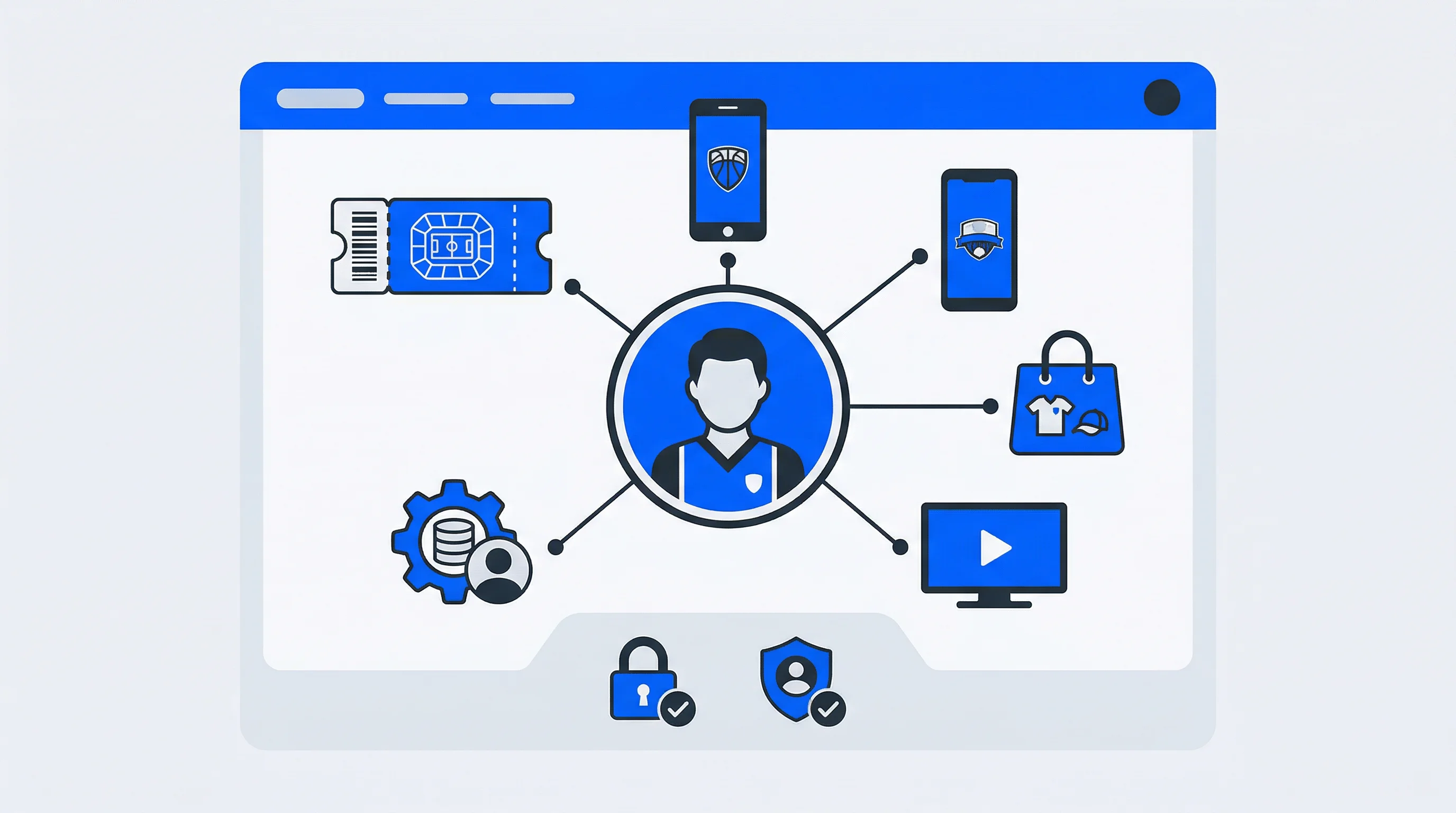
A fan buys a season ticket, downloads the club app, and orders a jersey online—yet the club sees three strangers instead of one loyal supporter. This fragmentation costs sports organizations revenue, personalization opportunities, and the unified fan relationships that drive long-term growth.
Customer Identity and Access Management (CIAM) solves this by connecting every digital touchpoint under a single fan identity. This guide covers how sports clubs, leagues, and federations use CIAM to unify fan data, streamline logins, enable personalized marketing, and turn identity infrastructure into measurable revenue.
What is CIAM for Sports Organizations
Customer Identity and Access Management (CIAM) is a system that handles how fans, members, and ticket holders log in and interact with a club's digital services. While traditional identity management focuses on employees accessing internal company systems, CIAM deals with external users—often millions of supporters who expect smooth experiences across ticketing, apps, merchandise stores, and content platforms.
For sports organizations, CIAM connects every fan-facing digital touchpoint under one identity. When a supporter buys a ticket, downloads the club app, or purchases a jersey online, CIAM links these interactions to a single profile rather than creating separate records in each system.
Three elements work together here: authentication (verifying who the fan is), profile management (storing and syncing their data), and consent handling (tracking what they've agreed to share).
Why Sports Clubs and Leagues Need Fan Identity Management
Fragmented Data Silos Across Ticketing, Apps, and Merchandise
Most sports organizations run multiple digital platforms that grew independently over time. The ticketing system knows who bought seats for Saturday's match. The mobile app tracks who checked the lineup. The online store records who purchased a replica kit. Yet these systems rarely talk to each other.
This fragmentation means a club might have three separate records for the same person, with no way to recognize that their most loyal season ticket holder is also their most frequent merchandise buyer.
Poor Fan Experience from Multiple Logins
Fans hit friction when they face separate login credentials for each club service. Forgotten passwords lead to abandoned purchases, and the frustration of creating yet another account discourages engagement with new digital offerings.
A supporter who wants to renew their membership, check match highlights, and order a birthday gift might authenticate three different times in a single session. Each additional login represents a potential drop-off point.
Limited Personalization Without Unified Profiles
Without a single view of each fan, clubs cannot tailor experiences based on actual behavior and preferences. The merchandise store cannot recommend products based on ticketing history. The content platform cannot prioritize videos featuring a fan's favorite players.
Growing GDPR Compliance Requirements
Sports organizations with European fans face strict data protection obligations under the General Data Protection Regulation (GDPR), with DLA Piper's 2026 survey reporting cumulative fines exceeding €7.1 billion since 2018. Managing consent becomes complicated when fan data spreads across multiple disconnected systems, each with its own privacy settings.
A fan who opts out of marketing in one system might continue receiving messages triggered by another. This inconsistency creates compliance risk and erodes trust.
How CIAM Unifies Fan Data Across Digital Touchpoints
Branded User Accounts as a Central Identity Hub
CIAM gives fans a single, club-branded account where they manage their profile information, communication preferences, and privacy settings. This account becomes the fan's digital home within the club ecosystem.
Organizations configure which data fields to collect, which login methods to offer (email, social login, passwordless options), and how the account interface reflects their brand identity.
Synchronizing Data Across CRMs, CDPs, and Ticketing Systems
The technical foundation of CIAM involves continuous two-way data synchronization with connected systems.
When a fan updates their address in their account, that change flows automatically to the CRM, ticketing platform, and any other integrated tools.
This synchronization happens through APIs (Application Programming Interfaces) and webhooks—automated notifications triggered by specific events. A ticket purchase, for example, can instantly update the fan's profile and trigger a personalized follow-up sequence in the marketing platform.
Creating a Single Source of Truth for Every Fan
CIAM establishes a central user ID that serves as the anchor point for all fan interactions. Every touchpoint—whether a website visit, app session, or in-stadium purchase—links back to this identifier.
The result is a 360° profile that aggregates behavioral data, transaction history, content preferences, and declared interests into one accessible record.
Key CIAM Use Cases in Sports
Sports organizations apply CIAM across numerous fan-facing scenarios:
- Ticketing and membership management: Linking ticket purchases to fan profiles enables personalized renewal reminders and seat upgrade offers based on attendance history.
- Stadium and venue access control: Verified digital identity supports contactless entry, VIP area access, and age verification for restricted zones.
- Merchandise and ecommerce personalization: Unified profiles power product recommendations based on purchase history and favorite players, while one-click checkout reduces cart abandonment.
- Content paywalls and media access: Premium video content and match highlights can be gated behind authenticated access, with entitlements managed through the fan's account.
- Fan club and community portals: Role-based access controls different membership tiers, granting exclusive content or early access to higher-tier members.
How Single Sign-On Transforms the Fan Experience
One Login Across All Club Services
Single Sign-On (SSO) allows fans to authenticate once and access every connected service without re-entering credentials. A fan who logs into the mobile app can seamlessly open the ticket portal or merchandise store without facing another login screen.
This capability relies on authentication standards like OpenID Connect (OIDC) and SAML, which enable secure identity sharing between applications.
Progressive Profiling to Enrich Fan Data Over Time
Rather than asking fans to complete lengthy registration forms upfront, progressive profiling collects additional information gradually across multiple interactions. After a fan's third login, the system might ask for their favorite player. A few visits later, it could request their shirt size.
This approach respects the fan's time while steadily building richer profiles. Each piece of voluntarily shared information—known as zero-party data—improves personalization accuracy.
Reducing Checkout Friction and Boosting Conversions
Pre-filled forms, saved payment methods, and one-click purchasing eliminate the friction points behind the average 70% cart abandonment rate that Baymard Institute documents across ecommerce. When the system already knows shipping addresses and preferences, completing a purchase takes seconds rather than minutes.
Most fans who start a purchase never finish it — friction is the reason
Enabling Personalized Fan Marketing with CIAM
Segmenting Fans by Behavior and Preferences
Unified profiles enable dynamic segmentation based on actual fan behavior rather than assumptions. Marketing teams can identify fans who attended away matches last season, those who engage primarily with video content, or supporters who purchase merchandise but have never bought tickets.
These segments update automatically as fan behavior changes.
Running ID-Based Campaigns Across Channels
With verified fan identities, clubs can reach known supporters through email, push notifications, SMS, and targeted advertising—without relying on third-party cookies or platform algorithms. This direct relationship becomes increasingly valuable as privacy regulations limit traditional tracking methods.
Real-Time Personalization at Every Touchpoint
Connected systems can customize experiences the moment a fan interacts. The website displays content featuring their favorite players. The app highlights upcoming matches they're likely to attend. In-stadium screens could eventually show personalized messages.
Turning Fan Identity into Revenue
Premium Memberships and Subscription Models
CIAM enables tiered membership structures where different access levels unlock different benefits. A basic free account might offer news and highlights, while premium tiers provide early ticket access, exclusive content, or merchandise discounts.
Managing these entitlements through a central identity system ensures fans receive exactly what they've paid for across all platforms.
Partner Integrations and Sponsor Activations
Sponsors increasingly want to reach verified, engaged fan audiences rather than anonymous impressions. CIAM allows clubs to offer consent-compliant access to fan segments, creating new revenue streams through data partnerships and targeted sponsor activations.
A sportswear partner, for example, might reach fans who've shown interest in fitness content, while a travel sponsor targets those who've attended away matches.
Maximizing Lifetime Value per Fan
The combination of personalized experiences, targeted offers, and reduced friction increases revenue per fan over time — McKinsey research shows personalization drives 10 to 15 percent revenue lift. Fans who feel recognized and valued engage more frequently and maintain their relationship with the club longer.
Knowing your fan turns every touchpoint into a revenue opportunity
GDPR Compliance and Fan Data Security
Transparent Consent Management
CIAM provides fans with clear consent screens explaining what data the club collects and how it will be used. A self-service cockpit allows fans to review and modify their preferences at any time, fulfilling GDPR's transparency requirements.
When consent settings change, those updates propagate automatically to all connected systems.
EU-Hosted Data and Privacy by Design
For organizations handling European fan data, hosting infrastructure within the EU simplifies compliance with data residency requirements. Privacy by design principles mean that data protection considerations are built into the system architecture rather than added afterward.
Securing Accounts with Modern Authentication
CIAM platforms offer security features including multi-factor authentication (MFA), passwordless login options, and fraud detection capabilities. These protections safeguard fan accounts without creating excessive friction for legitimate users.
How Federations Deploy CIAM Across Multiple Clubs
Centralized Identity Infrastructure for Leagues
Federations and leagues can provide a shared identity layer that member clubs adopt, eliminating the need for each club to build or procure their own solution. This approach reduces costs, accelerates deployment, and ensures consistent fan experiences across the league.
A national federation might offer CIAM as a service to member clubs, with each club maintaining their own branded experience while benefiting from shared infrastructure.
Delegated Administration for Member Clubs
Role-based access control (RBAC) allows federations to grant each club administrative access to their own fan data while maintaining oversight of the overall system. Clubs manage their specific relationships without accessing other clubs' information.
Unified Reporting with Club Autonomy
Federations gain aggregate insights across all member clubs—total registered fans, engagement trends, demographic patterns—while individual clubs retain full control over their specific fan relationships and data.
Integrating CIAM with Sports Tech Stacks
APIs, Webhooks, and Pre-Built Integrations
CIAM platforms connect to existing systems through multiple methods:
| Integration Method | Use Case | Technical Effort | Best For |
|---|---|---|---|
| Pre-built integrations | Common platforms (CRMs, CDPs, ticketing) | Low | Quick deployment |
| User API | Custom applications, unique workflows | Medium | Flexibility |
| Webhooks | Event-driven updates, real-time sync | Low-Medium | Automation |
OpenID Connect and SAML Compliance
Standards compliance ensures CIAM works with enterprise tools and third-party services. OpenID Connect handles modern web and mobile authentication, while SAML supports legacy enterprise applications. Both protocols enable secure identity federation without custom development.
Migrating Data from Legacy Fan Databases
Transitioning from existing systems involves data migration, user matching to identify duplicate records, and profile aggregation to merge fragmented information. A well-designed migration preserves historical data while establishing the unified foundation for future growth.
Building 360° Fan Profiles
Aggregating Zero-Party and First-Party Data
Comprehensive fan profiles combine two types of owned data:
- Zero-party data: Information fans voluntarily share—favorite team, communication preferences, declared interests, survey responses
- First-party data: Observed behavior—purchase history, content views, app usage, attendance records
Together, these data types create profiles far richer than either source alone.
User Matching Across Data Sources
CIAM identifies when the same fan exists in multiple systems under different identifiers—perhaps different email addresses or account names. Matching algorithms merge duplicate records into a single unified profile, eliminating redundancy and improving data quality.
Continuous Profile Enrichment Without Friction
Profiles grow richer with each fan interaction, automatically capturing new preferences, behaviors, and transactions. This continuous enrichment happens in the background, requiring no additional effort from fans.
Building a Digital Home for Your Fans
CIAM replaces fragmented systems with a unified identity foundation. The result is better fan experiences, stronger data for personalization, new revenue opportunities, and simplified compliance—all built on a single, branded digital relationship with each supporter.
Solutions like Unidy provide ready-to-go identity management with extensive integrations, EU hosting, and built-in monetization features. Whether you're a single club consolidating data silos or a federation rolling out identity services across member organizations, the path to unified fan identity starts with choosing the right platform. Book a demo to see how it works for your organization.
Frequently Asked Questions About CIAM for Sports Organizations
What is the difference between CIAM and a traditional CRM?
CIAM manages authentication, identity verification, and consent across digital services, while a CRM stores customer relationship data like contact history and sales records. CIAM feeds unified identity data into your CRM rather than replacing it—the two work together, with CIAM ensuring the CRM receives accurate, deduplicated fan information.
How long does CIAM implementation typically take for a sports club?
Implementation timelines vary based on the number of systems being connected and the complexity of data migration. Ready-to-go platforms with pre-built integrations can launch initial use cases within weeks, while comprehensive deployments involving legacy system migration might take several months.
Can CIAM integrate with existing ticketing providers?
Yes, CIAM platforms connect to ticketing systems via APIs, webhooks, or pre-built integrations. This synchronization links ticket purchases to fan profiles, enabling personalized communications and a complete view of each fan's attendance history.
How does CIAM handle fans who have accounts in multiple club systems?
CIAM uses user matching algorithms and data migration tools to identify duplicate records across systems. These records merge into a single unified profile based on a central user ID, consolidating what might have been three or four separate accounts into one complete fan record.
What return on investment can sports organizations expect from CIAM?
Organizations typically see value through higher conversion rates from reduced login friction, increased revenue from personalization, lower IT costs from consolidated systems, and improved fan retention from better experiences. Specific outcomes depend on implementation scope and how actively the organization uses unified data for engagement.
Does CIAM support both mobile apps and web platforms?
Yes, CIAM provides cross-platform authentication so fans use the same identity across mobile apps, websites, smart TV applications, and any other digital touchpoint. The experience remains consistent regardless of how fans choose to engage.
From Identity to Intelligence: How CIAM Powers AI Enablement
AI agents are already retrieving customer data, completing transactions, and personalizing experiences across digital services. The question is whether your identity infrastructure can tell the difference between a legitimate AI assistant acting on behalf of a user and an unauthorized system attempting to access sensitive information.
Data Sovereignty in Sports: Closing the Gap Between Clubs and Platforms
Sports clubs generate fan data across ticketing, streaming, merchandise, and membership platforms every day. The problem is that most of this data stays with the platforms, not the club.