

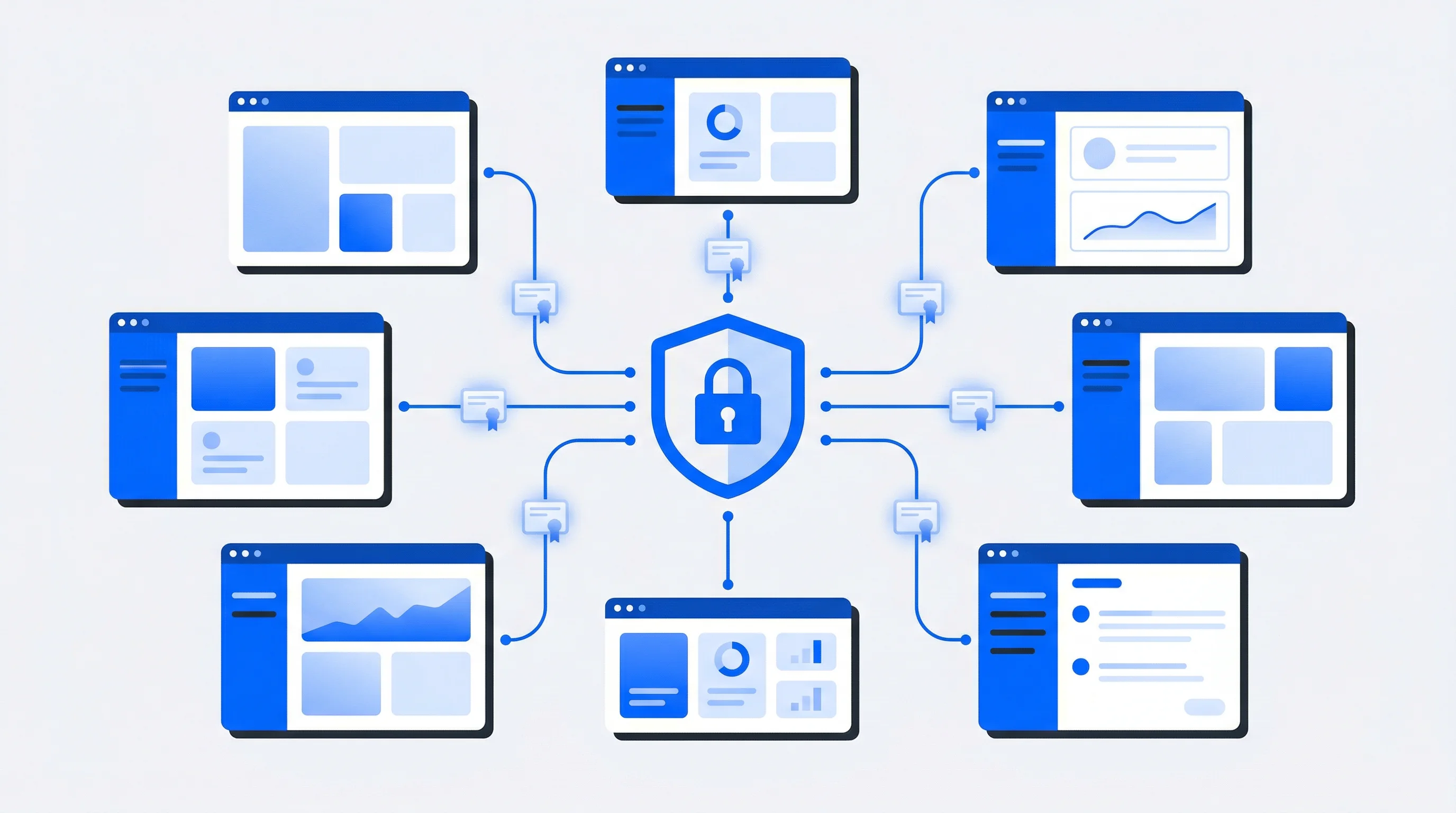
Unidy enables Single-Sign-On to provide a unified login experience for users across one or multiple brand platforms. But what is Single-Sign-On and why is it important at all?
A Single-Sign-On (SSO) is a technology that allows users to login in multiple applications or websites using a single set of credentials. Basically there is no need for creating a user account for every new website or app, since everything is unified. A Single-Sign-On offers several benefits.
Understanding Single Sign-On Technology
Single Sign-On (SSO) is an authentication method that enables users to securely authenticate with multiple applications and websites by using just one set of credentials. Instead of maintaining separate usernames and passwords for each service, SSO acts as a central authentication hub that verifies user identity once and then provides access to all connected systems.
Think of SSO as a master key that opens multiple doors. Once you authenticate with your SSO provider, you gain seamless access to all integrated applications — whether that's your company's CRM, marketing tools, content management systems, or customer portals. This unified approach eliminates the traditional model where each application requires its own separate login process.
SSO solutions typically implement industry-standard protocols such as OpenID Connect and SAML (Security Assertion Markup Language) to ensure secure communication between the identity provider and connected applications. This standardization allows organizations to integrate diverse systems while maintaining strong security practices.
How SSO Authentication Works
The SSO authentication process follows a structured sequence that ensures secure access while maintaining user convenience:
Step 1: Initial Access Request When a user attempts to access a protected application or website, the system detects that authentication is required. Instead of presenting a local login form, the application redirects the user to the configured SSO identity provider.
Step 2: Identity Provider Authentication The user is presented with the SSO login interface where they enter their credentials — username/password, or passwordless methods like biometrics or social login. The identity provider validates these credentials against the central user directory. Passkeys represent the next evolution of this step, replacing passwords entirely with device-bound cryptographic keys.
Step 3: Token Generation and Exchange Upon successful authentication, the identity provider generates a secure authentication token (typically a SAML assertion or JWT token) that contains the user's identity information and access permissions. This token is digitally signed to prevent tampering.
Step 4: Application Access Grant The identity provider redirects the user back to the original application along with the authentication token. The application validates the token signature and extracts the user's identity and permission information to grant appropriate access.
Step 5: Session Management Once authenticated, the user gains access to the requested application. The SSO session remains active, meaning subsequent access to other connected applications happens automatically without requiring additional login steps — creating a seamless user experience across the entire digital ecosystem.
Key Advantages of SSO Implementation
Implementing Single Sign-On delivers measurable benefits across user experience, security, and operational efficiency. Organizations typically see immediate improvements in user adoption, reduced IT support costs, and enhanced security posture. The following sections explore these advantages in detail, demonstrating why SSO has become essential for modern digital infrastructure.
Decreasing need for multiple passwords
Managing all passwords can be complicated and confusing. The SSO eliminates this difficulty and unifies the login. A single login and password is all that is needed to access all connected services. Users no longer have to remember different login details, but only their central authentication method (e.g. password or passwordless methods).
Stronger digitalisation
Digital transformation requires companies to look at their operations from a digital perspective. The SSO is the padlock that guarantees the integrity of the information and data stored and processed by the company. In this way, it fits perfectly with the requirements of today's and tomorrow's businesses.
Improved user experience
On the one hand, the SSO saves users time through automatic or 1-click login, but on the other hand, it can be annoying for users if they forget passwords and fail to log in. It can also lead to stressful situations, such as wanting to attend a meeting but not being able to. These problems can be solved with an SSO by improving the use of systems and devices in general and making logging in less time-consuming.
Increased productivity
Today, users increasingly need speed and continuity to carry out their activities with greater efficiency and agility. Thus, managing access requests manually is a process that frustrates users. With the SSO authentication, the need for manual supervision by the IT team is eliminated, allowing immediate access to countless applications and systems with a single click. In other words, it increases the productivity of the company and saves time for both users and supervisors.
Increased network security
SSO increases security in access management. The solution provides real-time information about which users have accessed applications (time and location) so IT teams can act quickly to protect the integrity of systems, meaning SSO increases the security capabilities of organisations. The SSO can also be combined with MFA (multi-factor authentication), which provides an additional layer of security and facilitates password recovery when needed.
Ensuring the GDPR compliance of companies
Data protection is a very important issue. Therefore, it is crucial that companies ensure that they comply with GDPR guidelines. SSO simplifies the process of data protection by combining multiple logins into one. Beyond compliance, SSO is the foundation for building first-party data strategies — every authenticated login creates a consented data relationship that becomes the cornerstone of a cookieless marketing future.
If you are interested in our SSO solution or you want to learn more about it, feel free to contact us.
Proven User Onboarding Best Practices for Growth
Most users who sign up for a product never become active users—the average activation rate is just 37.5% across B2B SaaS. The gap between registration and real engagement is where growth either happens or quietly dies.
What Is a White-Label Solution and Its Benefits?
Unidy is a White-Label Identity Solution. But what does that actually mean and what are the advantages of a white-label solution?