

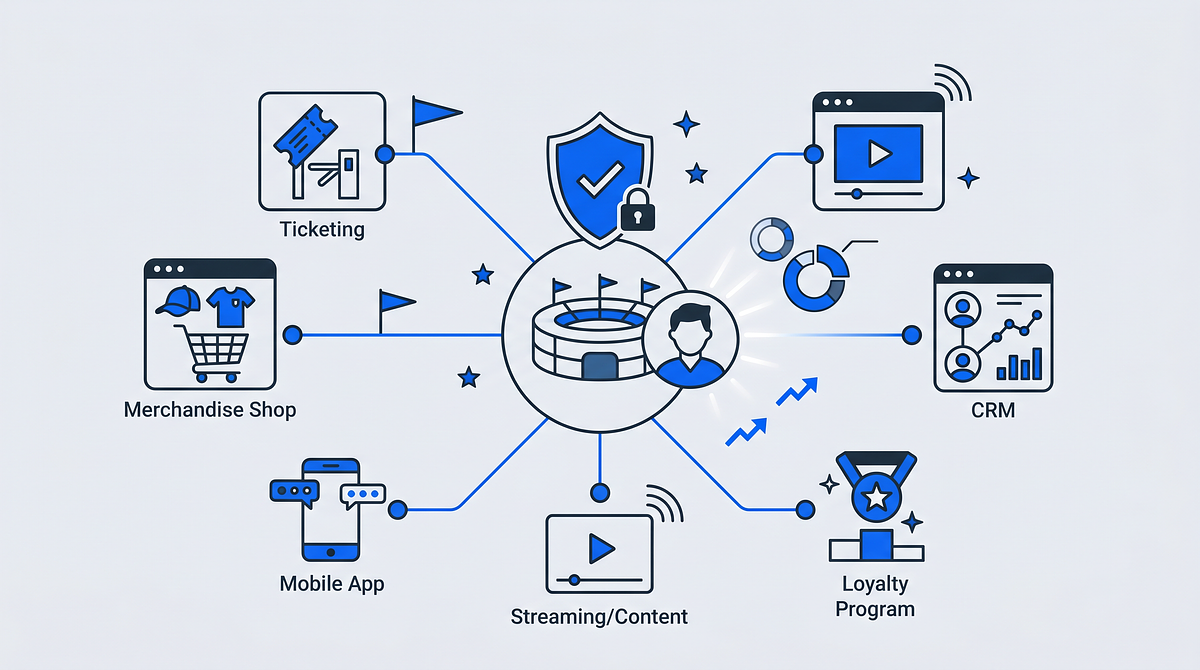
A fan engagement platform is a centralized digital solution that helps sports teams and leagues connect with supporters beyond match day by unifying fan data, logins, and consent across all touchpoints.
This article covers what a fan engagement platform does, why fragmented fan data costs clubs revenue, and how to evaluate platforms based on integration capabilities, GDPR compliance, and time to value.
What is a fan engagement platform?
A fan engagement platform is a centralized digital software solution that helps sports teams, leagues, and entertainment brands connect with supporters beyond match day. The platform captures zero-party data (information fans explicitly share, like their favorite player or communication preferences) and first-party data (behavioral data from your owned channels, like purchase history) to personalize interactions and create new revenue streams.
Think of it as the connective layer between all your fan touchpoints. Instead of separate logins for ticketing, merchandise, streaming, and your mobile app, a fan engagement platform brings everything together under one identity. When a fan buys a ticket, that information connects to their shop purchases, app activity, and content preferences.
The core functions include:
- Centralized fan identity: One login across web, app, ticketing, and shop
- Data collection and consent: Fan preferences and permissions gathered in one place
- Personalization: Content and offers tailored to individual fan profiles
- Revenue activation: Fan data connected to memberships, merchandise, and sponsorship
Why sports teams and leagues need a fan engagement platform
Fans interact with clubs through dozens of disconnected touchpoints: ticketing systems, online shops, mobile apps, social media, and stadium experiences. Each system often stores fan data separately, creating fragmented silos that make it difficult to recognize the same person across channels.
Without a central platform, a club might send a season ticket holder a generic email promoting tickets they already own. Or miss the chance to offer a personalized merchandise discount to someone who just attended their first match.
The commercial pain points are concrete:
- Fragmented fan data: Information scattered across ticketing, CRM, shop, and email tools with no unified view
- Low engagement between matches: No systematic way to maintain fan interest outside of game day
- Dependence on third-party platforms: Social media algorithms control when fans see your content, and owned channels are over twice as effective for revenue
- Compliance risk: Difficulty managing consent and GDPR requirements when data lives in multiple systems — a German football association was fined €300,000 under GDPR for failing to manage fan data properly
Key features of a fan engagement platform
Single Sign-On and branded fan account
Single Sign-On (SSO) gives fans one set of credentials to access all club services, whether buying tickets, browsing the shop, streaming content, or using the mobile app. Instead of remembering multiple passwords, fans log in once and move seamlessly between touchpoints.
The branded user account becomes the fan's central hub. Here they update their profile, manage communication preferences, and view their relationship with the club in one place. For the club, this creates a consistent identity that follows the fan everywhere.
Consent management and zero-party data collection
Zero-party data refers to information fans intentionally share. This might include their favorite player, preferred communication channels, or interest in specific content types—data you can gather incrementally through progressive profiling. Unlike third-party cookies (which track behavior across the web), zero-party data comes directly from the fan with explicit consent.
Consent management ensures GDPR compliance by recording exactly what each fan has agreed to receive. When a fan updates their preferences, those changes sync across all connected systems automatically.
Integrations with CRM, ticketing, shop, and OTT
A fan engagement platform connects to your existing technology stack through APIs, webhooks, and authentication standards like OpenID Connect (OIDC) and Security Assertion Markup Language (SAML). OIDC and SAML are protocols that allow secure, standards-based data exchange between systems.
The practical result: when a fan makes a purchase in your shop, that information flows into your CRM. When they watch a match on your OTT platform, their engagement data enriches their profile. The fan experiences one seamless relationship with the club, while your systems stay synchronized.
Personalization and fan segmentation
Unified fan profiles enable meaningful segmentation. You might distinguish between season ticket holders, occasional match-goers, international digital fans, and youth academy supporters. Each group has different interests and different value to the club.
Personalization means delivering relevant content, offers, and communications based on segment and individual behavior. A fan who regularly buys away match tickets receives different messaging than one who only attends home fixtures.
Premium memberships and ID-based campaigns
When you can reliably identify fans across touchpoints, monetization becomes more sophisticated. Tiered membership programs can offer exclusive content, early ticket access, digital membership cards, or partner discounts based on fan status.
ID-based campaigns connect specific fan segments to sponsor activations. Rather than broad demographic targeting, you can demonstrate to partners exactly which fans engaged with their content and what actions they took afterward.
How a fan engagement platform supports revenue and fan loyalty
The connection between platform capabilities and commercial outcomes is direct:
| Platform Capability | Business Outcome |
|---|---|
| Single Sign-On across all services | Higher conversion through reduced friction |
| 360° fan profiles | Relevant offers that increase purchase frequency |
| Consent-based data collection | GDPR compliance and advertiser-safe data |
| Premium membership tiers | Recurring revenue from loyal fans |
| ID-based campaign targeting | Higher sponsorship value and measurable ROI |
When fans can complete purchases with one click using stored preferences, conversion rates improve.
When offers match actual interests, average order values increase. When sponsors can see verified engagement metrics, partnership deals become more valuable — 62% of brands say improved data is the key to better partnerships.
What is a unified fan profile and why does it matter?
A 360° fan profile aggregates all data about a single supporter into one central record: purchases, attendance history, app usage, content preferences, and consent status. This unified view becomes the foundation for every personalized interaction.
You cannot personalize what you cannot recognize. If your ticketing system sees "John Smith" and your shop sees "J. Smith" and your app sees "jsmith@email.com," you have three incomplete pictures instead of one complete one.
Identity management infrastructure solves this by matching and merging records from existing silos based on a central fan ID. Platforms like Unidy provide this capability with pre-built integrations for CRMs, ticketing systems, and commerce tools, reducing the technical complexity of unification.
How to build a fan engagement strategy across digital and match day touchpoints
Step 1. Audit existing fan data and logins
Start by inventorying every system where fan data currently lives. How many separate logins do fans use today? Where are there data gaps, and where are there duplicates? This audit reveals the scope of fragmentation you are addressing.
Step 2. Define fan segments and engagement goals
Determine which fan groups matter most to your commercial objectives. Local season ticket holders, international digital fans, and casual attendees each require different engagement approaches. Set specific, measurable goals for each segment.
Step 3. Centralize identity and consent
Implement a central identity layer that unifies logins and consolidates consent management. This typically involves migrating existing fan records and matching duplicates into single profiles. The technical foundation here determines everything that follows.
Step 4. Activate personalized campaigns across touchpoints
With unified data in place, deliver relevant messages via email, app push notifications, in-stadium screens, and web personalization. Run ID-based campaigns that connect online behavior to match day experiences, creating a continuous relationship rather than isolated interactions.
Step 5. Measure, optimize, and scale
Track engagement KPIs consistently across segments. Test different approaches and learn what resonates with each group. As you demonstrate results, expand to new touchpoints and partner activations.
Fan engagement KPIs and metrics that matter
Registered and opted-in fans
This metric represents the size of your addressable, consent-based fan database. It is the foundation for all owned-channel marketing and the starting point for reducing dependence on third-party platforms.
Conversion and activation rates
What percentage of registered fans purchase, attend, or engage with campaigns? This measures whether your personalization efforts actually drive action, not just opens and clicks.
Retention and churn
How many fans remain active over time? This shows whether engagement efforts sustain interest between seasons or whether you are constantly refilling a leaky bucket.
Average revenue per fan
Total revenue divided by fan count gives you the key metric for demonstrating ROI on engagement investments. Tracking this over time reveals whether your platform is genuinely increasing fan lifetime value.
How to choose the right fan engagement platform for your club or league
Integrability and standards support
Check for ready-made integrations with your existing tools: CRM, ticketing, shop, and streaming platforms. Look for OpenID Connect and SAML support, which ensure secure, standards-based SSO that works with enterprise systems.
GDPR compliance and EU hosting
Confirm that data is hosted within the EU if that is relevant to your fan base. Verify the platform provides transparent consent management with audit trails that demonstrate compliance.
Branded user experience
The fan-facing login and account screens should offer a white-label experience fully customizable to your club's visual identity. Fans interact with the club, not a third-party tool.
Time to value and total cost of ownership
Evaluate implementation timeline and ongoing costs realistically. Ready-to-go platforms with pre-built integrations reduce IT burden compared to custom-built solutions.
Evaluation checklist:
- Does the platform integrate with our current CRM, ticketing, and shop systems?
- Is data hosted in the EU with GDPR-compliant consent management?
- Can we fully brand the fan login and account experience?
- What is the implementation timeline and total cost?
- Does it support both web and mobile app SSO?
Turning fan identity into long-term digital growth
Owning fan identity and consent is the foundation for sustainable engagement and revenue growth. Clubs that control this relationship reduce dependence on social media algorithms and third-party data brokers, building direct connections that compound over time.
For sports teams and leagues looking to centralize fan identity, Unidy provides a ready-to-go identity management and SSO platform with 100+ integrations, EU hosting, and built-in consent management.
Frequently asked questions about fan engagement platforms
How is a fan engagement platform different from a CRM?
A CRM stores and manages fan records, while a fan engagement platform provides the identity layer (login, consent, and profile) that feeds accurate, unified data into the CRM. The engagement platform sits upstream, ensuring the CRM receives consistent fan information from all touchpoints rather than fragmented, duplicate records.
Can a fan engagement platform help with GDPR compliance?
Yes. A fan engagement platform centralizes consent collection and management, giving fans transparency over their data and giving clubs auditable records of permissions. EU-hosted platforms provide additional data residency assurance for organizations with European fan bases.
How long does it typically take to implement a fan engagement platform?
Implementation timelines vary based on the number of systems to integrate and the volume of data to migrate. Ready-to-go platforms with pre-built integrations can launch initial use cases within weeks, while custom-built solutions often take months or longer.
Is a fan engagement platform only for large clubs with big budgets?
Platforms with usage-based pricing and pre-built integrations make identity management accessible to smaller clubs and leagues without requiring large IT teams or custom development. The key is finding a solution that matches your current scale while allowing room to grow.
Digital Membership Cards Made Simple with Unidy
A digital membership card is a smartphone-based credential that replaces traditional plastic cards, stored in Apple Wallet or Google Wallet and scanned via QR code or NFC for instant access to member benefits.
What Is Federated Identity and How Does It Work?
Federated identity is a system that links a user's digital identity across multiple separate organizations, allowing them to log in once and access various applications without re-authenticating at each one. When you click "Sign in with Google" on a third-party website, you're using federated identity—Google confirms who you are so the other site doesn't have to manage your credentials.