

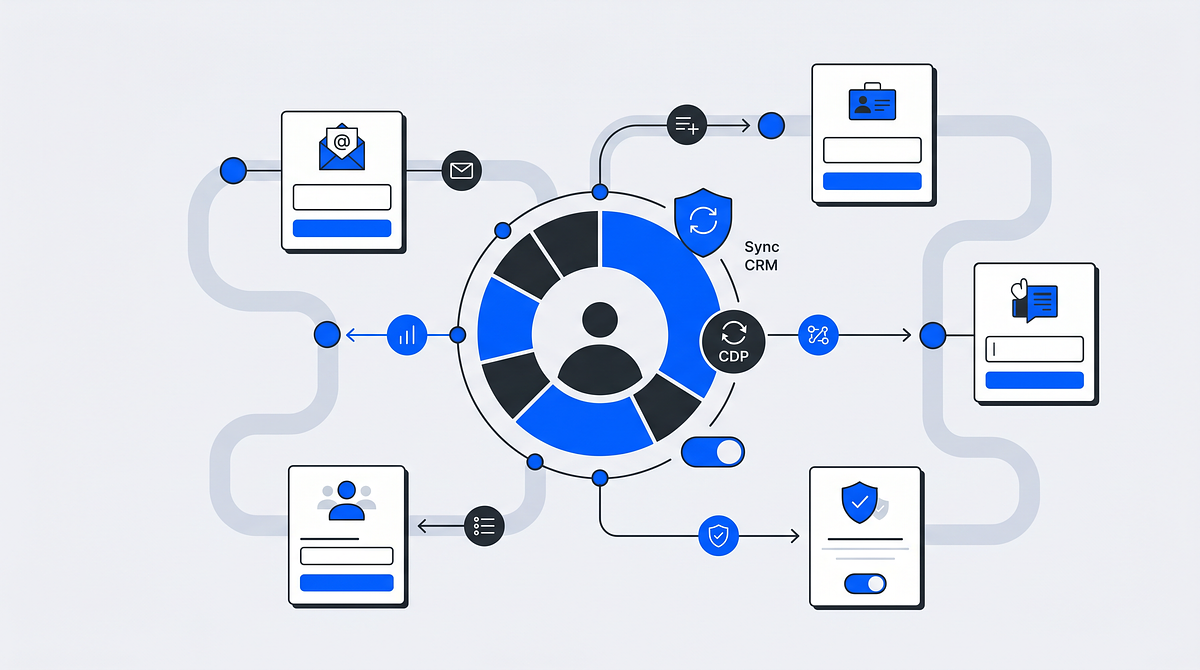
Long registration forms are conversion killers. When users see 10 fields standing between them and your content, most of them leave.
Progressive profiling takes a different approach: instead of asking for everything upfront, you collect customer data gradually across multiple interactions. A user shares their email today, their job title next week, and their preferences after their third visit. This article covers how progressive profiling works, which data to collect at each stage of the customer journey, and how to build the infrastructure that makes gradual data collection possible.
What is progressive profiling?
Progressive profiling is a data collection method that gathers customer information gradually across multiple interactions instead of asking for everything at once. Rather than presenting a 10-field registration form at signup, you ask for an email address first. Then, on the next visit, you ask for a job title. After a purchase, you request preferences. Each touchpoint adds one or two data points to the user's profile.
The core idea is simple: shorter forms get completed more often. When users see a long form, they frequently abandon it — 27% cite form length as the reason. Progressive profiling sidesteps this problem by spreading data requests across the customer relationship.
Long forms don't just annoy users — they kill the data you're trying to collect
Over time, this approach builds richer profiles than traditional forms ever could. A user who would never complete a 15-field registration might happily answer 15 single questions spread across months of engagement.
How does progressive profiling work?
Progressive profiling depends on several technical pieces working together. Understanding how each component functions helps clarify why gradual data collection works in practice.
Smart forms and dynamic form fields
Smart forms check what data already exists in a user's profile before displaying any fields. If someone provided their email last week, the form shows a different question this week, perhaps asking about their industry or content preferences.
Dynamic form fields make this possible. The form logic queries the user's existing profile, then renders only the fields that remain unanswered. Users never see the same question twice, and each interaction feels relevant to where they are in the relationship.
Behavioral and event-based triggers
Data requests work best when they appear at the right moment. Behavioral triggers initiate requests based on specific user actions.
Consider a few examples:
- A user downloads their third whitepaper, and a form asks about their role
- Someone completes a first purchase, and a follow-up requests size preferences
- A visitor returns for the fifth time, and a prompt asks about their interests
Connecting data collection to engaged moments increases completion rates because users are already invested in the interaction.
Central user profile and data storage
Progressive profiling requires a single place to store all collected data. Without a unified user profile, information gathered at different touchpoints stays fragmented across systems.
An identity management layer serves as this foundation. It maintains one record per user and accumulates data from every interaction, regardless of which service or channel captured it.
Synchronization with CRM, CDP, and marketing tools
Collected data becomes useful only when it reaches the systems that act on it. Progressive profiling implementations typically sync with Customer Relationship Management (CRM) systems, Customer Data Platforms (CDP), and marketing automation tools.
When a user shares preferences on your website, that information flows to your email platform, your ad targeting system, and your sales team's CRM. Without this synchronization, progressive profiling creates data that sits unused.
Why does progressive profiling matter for customer data growth?
Progressive profiling affects four outcomes that directly connect to revenue and customer relationships:
- Lower abandonment rates: Users complete shorter forms more often. A 3-field form converts better than a 10-field form.
- Higher data accuracy: When you ask for information in context, users give more thoughtful answers. Asking about content preferences after someone browses your library yields better data than asking during initial signup.
- More complete profiles: Gradual collection builds comprehensive user profiles over time. Each interaction adds another layer of understanding.
- Stronger trust: Asking for data incrementally signals respect for the user's time. This builds confidence, making users more willing to share additional information later.
How to map progressive profiling to the customer journey
The real value of progressive profiling comes from matching data requests to journey stages. Here is how that mapping typically works.
Step 1: Anonymous visitor and first touch
At this stage, you know nothing about the visitor. The goal is converting them to a known user with minimal friction.
Collect only essential data: an email address, perhaps a name. Some organizations skip forms entirely here, relying on behavioral tracking until the user takes a higher-intent action like downloading content or starting a purchase.
Step 2: Sign-up and account creation
When a user creates an account, keep the initial form short. Email and password are often enough. Adding a name field is reasonable. Anything beyond that can wait.
The temptation to ask for everything now is strong. Resist it. Users who abandon lengthy registration forms represent lost opportunities that follow-up emails cannot recover.
Step 3: Active engagement and returning users
As users return and engage through purchases, content consumption, or feature usage, you earn the right to ask for more.
Request data relevant to their activity. If someone browses your product catalog repeatedly, ask about their preferences. If they attend a webinar, ask about their role or challenges. Context makes requests feel helpful rather than intrusive.
Step 4: Loyalty, membership, and premium conversion
At high-trust stages, users willingly share more detailed information when they receive clear value in return.
Premium membership signups, loyalty program enrollment, or personalized service requests are appropriate moments to collect payment information, detailed preferences, or comprehensive profile data. The value exchange is explicit: users share more because they receive more.
What types of customer data can you collect progressively?
Progressive profiling typically gathers four categories of customer data. Each has different characteristics and optimal collection timing.
| Data Type | Definition | Example | When to Collect |
|---|---|---|---|
| Zero-party data | Information users intentionally share | Product preferences, interests | After initial engagement |
| First-party behavioral | Observed interaction data | Pages viewed, purchases | Ongoing, passive |
| Demographic | Profile attributes | Location, job role | Sign-up and follow-up |
| Consent data | Permissions and preferences | Marketing opt-ins | At registration, refresh periodically |
Zero-party data
Zero-party data refers to information users proactively and intentionally share. Product preferences, stated interests, and purchase intentions fall into this category.
Because users consciously provide this data, it tends to be accurate and directly actionable for the personalization 71% of consumers now expect. Progressive profiling excels at collecting zero-party data because it asks for preferences at moments when users are thinking about those topics.
First-party behavioral data
First-party data comes from observing user interactions on your own platforms. Browsing behavior, purchase history, content consumption, and feature usage all qualify.
Unlike zero-party data, first-party behavioral data is collected passively. Progressive profiling complements it by filling gaps that behavior alone cannot reveal, like why someone browses certain products or what they plan to do next.
Demographic and profile data
Standard profile fields like location, job title, and company size round out the customer picture. Spreading demographic questions across multiple touchpoints prevents the "interrogation" feeling that long forms create.
Consent and preference data
Collecting and managing user consents is both a legal requirement under regulations like GDPR (General Data Protection Regulation) and a trust-building practice.
Progressive profiling includes consent collection as part of the data gathering process. Each new data request can include appropriate consent options, and preference centers allow users to update their choices over time.
Best practices for progressive profiling
Effective progressive profiling balances data collection goals with user experience. A few principles guide this balance.
Keep the initial signup short
Limit initial registration to essential fields only. Email and password are often sufficient. The goal at signup is conversion, not comprehensive data collection.
Ask only for relevant data in context
Request data that relates to the user's current activity. Asking for a job title during a content download makes sense. Asking for it during newsletter signup feels disconnected.
Tie each data request to a clear user benefit
Users share data when they understand what they receive in return. "Tell us your industry so we can send you relevant case studies" works better than "Please complete your profile."
Integrate progressive profiling with Single Sign-On
Single Sign-On (SSO) creates a central identity layer where progressive profiling data accumulates across all touchpoints. When users log in once and access multiple services, each service can contribute to and benefit from the unified profile.
Respect consent and GDPR requirements
Each data request represents an opportunity to demonstrate transparent data practices. Include clear consent options, explain how data will be used, and ensure users can access and manage their information through a central interface.
Common challenges of progressive profiling and how to solve them
Progressive profiling is not without obstacles. Here are common challenges and practical solutions.
Form abandonment and user friction
Even short forms can cause abandonment if they appear at the wrong moment or ask for sensitive information too early. Testing form length and timing helps identify what works for your audience. Progress indicators and immediate value after each submission also reduce friction.
Fragmented data across silos
Progressive data collected in different systems, such as your website, mobile app, and customer service platform, creates incomplete profiles if those systems do not communicate.
A central identity layer solves this by unifying data from all sources into a single user profile. This is where identity management platforms become essential infrastructure rather than optional tooling.
GDPR compliance and consent risks
Collecting data without proper consent creates legal risk — GDPR fines now exceed €7.1 billion — and erodes user trust.
Consent isn't just about trust — non-compliance carries measurable financial risk
Transparent consent management with clear opt-in flows for each data request addresses both concerns. A central place where users can view and manage their data and permissions supports compliance and builds confidence.
When progressive profiling is not the right approach
Progressive profiling works best for ongoing relationships with repeat interactions. It is less suitable for one-time transactions, situations where regulations require full upfront data collection, or low-engagement business models where users rarely return.
Building a central identity layer for progressive profiling
Progressive profiling requires infrastructure that can store, manage, and synchronize user data across all touchpoints. Without a central identity layer, data remains scattered and the benefits of gradual collection disappear.
An identity management platform provides this foundation. It maintains unified user profiles, manages consent, and connects to downstream systems like CRMs, CDPs, and marketing tools. When a user shares information on any connected service, that data flows to the central profile and becomes available everywhere.
For organizations running multiple digital services, a branded user account with a central data and consent cockpit gives users visibility into what they have shared and control over their preferences. This transparency supports both GDPR compliance and the trust-building that makes progressive profiling effective over time.
How is progressive profiling different from standard customer profiling?
Standard customer profiling collects all data at once, typically through long registration forms. Progressive profiling gathers data gradually over multiple interactions, reducing friction and improving completion rates.
What are the four categories of customer data?
The four categories are zero-party data (user-provided preferences), first-party data (observed behavior on your platforms), second-party data (shared from partners), and third-party data (purchased from external sources). Progressive profiling focuses primarily on collecting zero-party and first-party data.
Is progressive profiling compliant with GDPR?
Yes, when implemented with transparent consent management. Each data request includes clear consent options, and users can view and manage their data and permissions through a central interface.
How does progressive profiling work with Single Sign-On?
Single Sign-On creates a central user identity across all connected services. Progressive profiling builds on this by gradually enriching the central profile as users interact across different touchpoints, with each service contributing to and benefiting from the unified data.
::
The Preußen-ID: From Concept to Close to 100,000 Fans in Six Weeks
In February 2026, SC Preußen Münster launched the Preußen-ID — a unified fan identity that today connects close to 100,000 users and a six-digit number of opt-ins in a single profile. Member onboarding has run automatically ever since. Manual list management is gone.
SAML vs. OIDC: Best Protocol for Your Business
What are SAML (Security Assertion Markup Language) and OIDC (OpenID Connect)? Both are authentication protocols that enable Single Sign-On (SSO). Which one is better suited for your business? We introduce both protocols, how they work, their features, and which one is best for your company.