

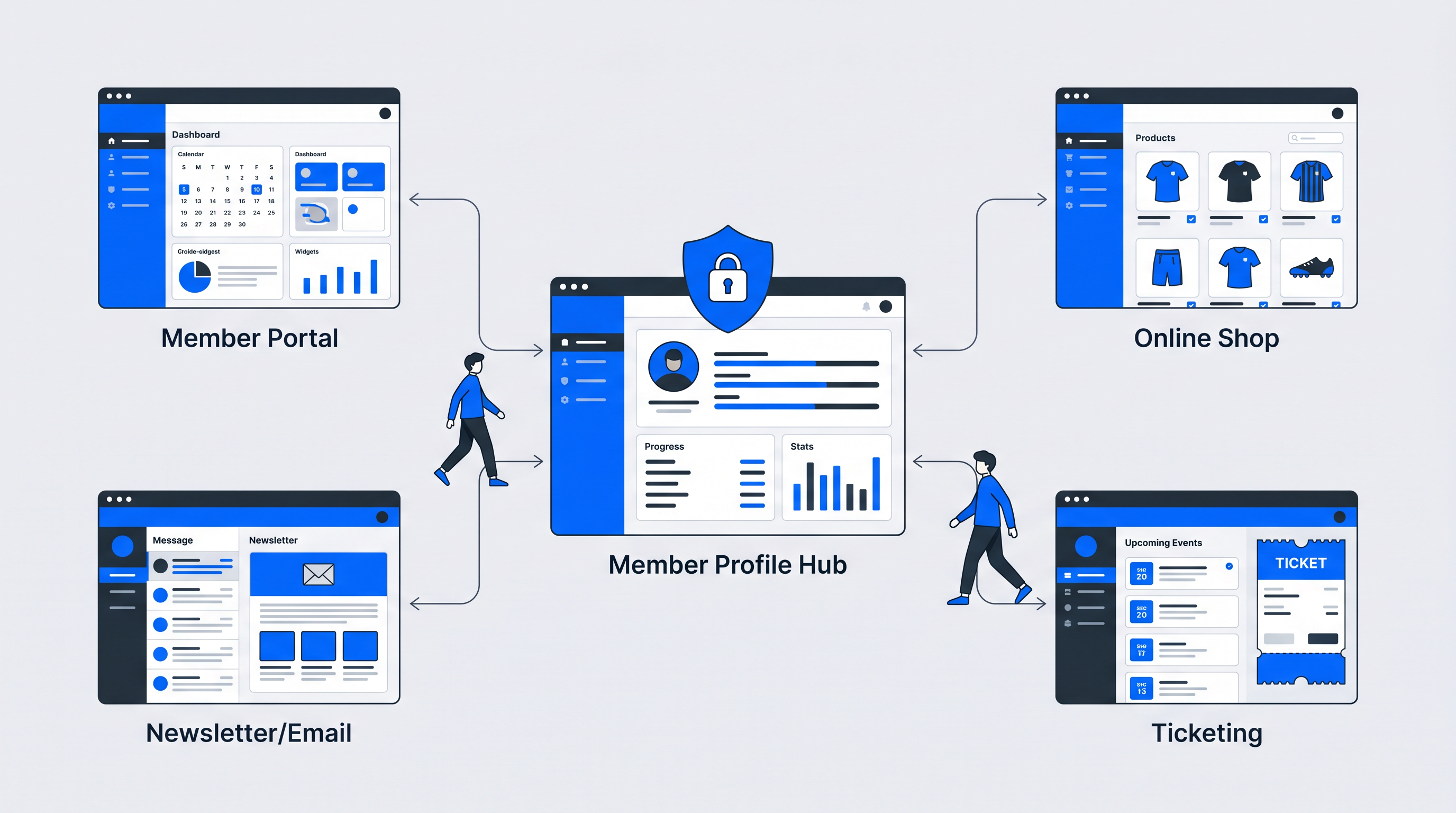
Single Sign-On (SSO) is an authentication method that allows users to access multiple, independent applications with one set of credentials—logging in once to reach everything from a member portal to a shop, ticketing system, and newsletter without re-entering passwords.
For clubs and membership organizations, SSO solves a practical problem: members interact with your brand across many digital touchpoints, and each separate login creates friction, data silos, and missed opportunities. This guide covers how SSO works, the protocols behind it, security considerations, and how to bring member login, shop, ticketing, and newsletter together under one identity layer.
What is Single Sign-On for clubs and member organizations
Single Sign-On (SSO) is an authentication method that allows members to access multiple, independent applications—like a club shop, ticketing system, newsletter, and member portal—using one set of credentials. Instead of creating separate accounts for each service, a member logs in once and moves freely between connected touchpoints without entering passwords again.
For clubs and membership organizations, SSO solves a specific problem: managing customer and member identity across many digital services. The focus here is different from employee access in a corporate setting. It's about creating a smooth experience for fans, supporters, or members who interact with your brand in multiple places.
A helpful way to picture this: think of SSO like a wristband at a festival. You check in once at the entrance, and then you can access any stage, food area, or VIP section without showing your ticket again. The wristband proves who you are everywhere you go.
- One login, many services: Members authenticate once and access shop, ticketing, content, and newsletter without re-entering credentials.
- Central member identity: All interactions link back to a single member profile.
- Reduced friction: No more juggling multiple passwords across club touchpoints.
How Single Sign-On works for member login, shop, and ticketing
SSO works through a trust relationship between two types of systems. When a member logs in, one central system verifies their identity and creates a digital token. Connected services accept this token as proof of who the member is, so there's no second login required.
The role of the Identity Provider and Service Provider
The Identity Provider (IdP) is the central system that authenticates members and stores their credentials. When someone logs in, the IdP confirms their identity and issues a token.
A Service Provider (SP) is any connected application—your shop, ticketing platform, newsletter tool, or content portal—that trusts the IdP. Rather than managing its own login system, each SP accepts the IdP's confirmation that the member is legitimate.
Here's how the flow typically works: A member visits your ticketing site. The ticketing site redirects them to the IdP for login. After the member enters their credentials, the IdP verifies them and sends a token back to the ticketing site. The ticketing site reads the token and grants access. If the member then visits the shop, the shop checks with the IdP, sees the valid token, and lets them in without another login.
How SSO tokens and JWTs carry member identity
After a successful login, the IdP issues a digital token containing member identity information. This token often takes the form of a JSON Web Token (JWT)—a compact, secure package of data that includes details like the member's ID, email, and permissions.
The JWT travels with the member as they move between services. When the member goes from the fan portal to the shop, the shop reads the token, recognizes who they are, and grants access without asking for credentials again. This handoff happens in the background, making the experience feel seamless.
JWTs have three parts: a header (which describes the token type and encryption method), a payload (which contains the member data), and a signature (which verifies the token hasn't been tampered with).
Key benefits of SSO for clubs and membership platforms
SSO delivers advantages that touch member experience, revenue, and daily operations.
- Better member experience: One login across all digital touchpoints reduces frustration and drop-off during checkout or registration.
- Higher conversion rates: Members complete purchases and sign-ups faster when they don't face repeated login screens.
- Unified member data: All activity flows into a central profile, giving you a complete picture of each member's interactions.
- Reduced support burden: Fewer password reset requests—which account for 30% of helpdesk tickets—and login issues mean less strain on your support team.
- Consistent security policies: You can enforce Multi-Factor Authentication (MFA) and access rules across all services from one place.
- Simpler onboarding and offboarding: Adding or removing member access to all services happens with a single action.
Why member login, shop, ticketing, and newsletter belong together
When each service manages its own login, you end up with data silos. The shop knows what a member bought, but the ticketing system doesn't. The newsletter tool has opt-in preferences, but the member portal can't see them. This fragmentation creates a disjointed experience for members and missed opportunities for your club.
Bringing login, shop, ticketing, and newsletter under one identity layer changes the picture entirely.
One member account across every club touchpoint
A central member account becomes the single source of truth. Members manage their data and preferences in one place—often called a branded user account or consent cockpit—while your club sees complete activity history across every interaction.
This approach means you're no longer piecing together who your members are from incomplete data scattered across disconnected systems. Instead, you have one profile that captures purchases, ticket history, newsletter engagement, and content preferences.
Connecting shop and ticketing for one-click conversions
With SSO in place, a member logged into the fan portal can purchase merchandise or tickets without re-authenticating. The seamless checkout already knows who they are, what payment methods they've saved, and their shipping preferences.
This seamless flow supports goals like increased revenue per member and higher conversion rates at critical moments—like when a limited-edition jersey drops or playoff tickets go on sale.
Linking newsletter opt-ins to central member profiles
Consent and communication preferences become part of the member profile rather than scattered across tools. When a member opts into the newsletter during ticket checkout, that preference syncs to the central identity.
This connection enables compliant, personalized outreach based on zero-party data—information members intentionally share, like interests and preferences—and first-party data you collect directly through your own channels.
Common SSO protocols and standards for customer identity
When implementing SSO, you'll encounter industry-standard protocols that ensure different systems can work together. Understanding the basics helps you evaluate options and communicate with technical teams.
Security Assertion Markup Language (SAML)
SAML 2.0 is an XML-based protocol widely used in enterprise settings to exchange authentication and authorization data between an IdP and SPs. It's mature and well-supported by many legacy systems, though it's more complex to implement than newer alternatives.
SAML works well for B2B integrations and internal tools, but its XML format can feel heavy for modern web and mobile applications.
OpenID Connect (OIDC) and OAuth 2.0
OpenID Connect (OIDC) is a modern identity layer built on top of OAuth 2.0. OAuth handles authorization—determining what you can access—while OIDC adds authentication—confirming who you are.
For customer-facing applications like member portals, shops, and mobile apps, OIDC is often preferred because of its simplicity and flexibility. It uses JSON instead of XML, making it lighter and easier to work with in modern development environments.
Kerberos and legacy enterprise protocols
Kerberos is a network authentication protocol common in on-premises Windows environments. It's less relevant for customer-facing SSO, but clubs may encounter it when integrating with internal systems or legacy infrastructure.
| Protocol | Best for | Complexity | Common use case |
|---|---|---|---|
| SAML 2.0 | Enterprise apps, legacy systems | Higher | B2B integrations, internal tools |
| OpenID Connect | Customer-facing apps, modern services | Lower | Member portals, shops, mobile apps |
| OAuth 2.0 | Authorization (API access) | Medium | Third-party app permissions |
Types of Single Sign-On for customer identity and access management
SSO solutions come in different deployment models. The right choice depends on your club's technical resources and strategic priorities.
Cloud-based customer identity SSO
Cloud-based SSO is delivered as a service and hosted by the provider. This model offers faster implementation, automatic updates, and managed infrastructure. It's well-suited for clubs without large IT teams or those looking to move quickly.
On-premises and self-hosted SSO
On-premises SSO means installing and managing software on your own servers. This approach offers more control over data and configuration but requires dedicated IT resources to maintain. Open-source options like Keycloak exist for organizations that prefer this path.
Social login and federated identity
Social login allows members to authenticate using existing accounts from Google, Facebook, or Apple. Federated identity is the broader concept of trusting external identity providers to verify user identity.
The trade-off here is convenience versus data ownership. Social login reduces friction for members, but you become dependent on big tech platforms and don't fully own the member relationship. If a member signs up with their Facebook account, Facebook sits between you and that member's identity.
Is Single Sign-On secure for member data
Security is often the first question clubs ask about SSO. The answer involves both advantages and considerations worth understanding.
On the positive side, SSO can actually improve security in several ways:
- Fewer passwords to compromise: Members maintain one strong password instead of many weak ones—94% of passwords are reused according to a 2025 Cybernews study—spread across services—or adopt passwordless authentication to eliminate passwords entirely.
- Consistent policy enforcement: You can apply MFA and password requirements uniformly across all connected services.
- Centralized monitoring: Suspicious login activity across all services becomes visible from one place.
- Faster response to breaches: Revoking access to all services happens by disabling one account.
However, SSO does create a single point of failure. If the SSO account is compromised, attackers could potentially access all connected services.
Mitigation strategies include enforcing MFA, monitoring for unusual activity, implementing session timeouts, and maintaining strong password policies. With these measures in place, the security benefits of SSO typically outweigh the risks of fragmented login systems where members reuse weak passwords.
SSO, GDPR, and consent management for clubs
For clubs operating in the EU, where cumulative GDPR fines exceed €7.1 billion according to DLA Piper's 2026 survey, SSO and data protection compliance work together naturally. A central identity layer supports transparent consent management in several practical ways.
- Centralized consent records: All opt-ins and preferences are stored with the member profile, not scattered across systems.
- Transparent data cockpit: Members can view and manage what data the club holds and how it's used.
- Zero-party data collection: Information members intentionally share—like interests and preferences—links to their verified identity.
- First-party data ownership: Your club owns the member relationship directly, independent of big tech platforms.
- EU hosting considerations: For GDPR compliance, providers with EU-based data processing offer additional assurance.
Platforms like Unidy provide EU-hosted infrastructure with built-in consent management as part of the SSO solution, addressing both technical and regulatory requirements in one layer.
How to implement Single Sign-On in a club tech stack
Moving from fragmented logins to unified identity involves several practical steps.
1. Audit existing logins and member data silos
Start by inventorying all systems that require member authentication: shop, ticketing, CMS, newsletter, apps. Identify where member data currently lives and how accounts are managed today. This audit reveals the scope of integration work ahead.
2. Choose your Identity Provider and protocols
Evaluate SSO providers based on integration options, whether SAML or OIDC best fits your architecture, compliance features, and fit for customer identity use cases. Consider whether a cloud-based or self-hosted solution aligns with your resources and timeline.
3. Migrate and match existing member accounts
Plan how to consolidate existing accounts from different systems into central profiles. Address user matching—the same member might use different emails across systems—and define data migration strategies. This step often takes more time than expected.
4. Connect shop, ticketing, and newsletter via APIs and webhooks
Integrate service providers with the IdP using available connectors, APIs, or webhooks. Ensure member identity and relevant profile data sync bidirectionally where needed. Many modern SSO platforms offer pre-built integrations for common tools.
5. Configure consent, user groups, and access rights
Set up consent flows and define member segments—premium members, general fans, season ticket holders. Configure role-based access control (RBAC) for different services and content. This configuration determines who can access what across your connected services.
What to look for in an SSO provider for clubs
Not all SSO solutions are built for customer and member identity. When evaluating providers, consider criteria specific to clubs and membership organizations.
- Customer identity focus: The provider specializes in customer/member identity, not just employee access.
- Integration breadth: Ready-made connectors for CRMs, CDPs, shops, ticketing, and marketing tools.
- Protocol compliance: Full support for OpenID Connect and SAML standards.
- Consent and GDPR features: Built-in consent management, data cockpit for members, and EU hosting options.
- Branding flexibility: Ability to customize login screens and member accounts to match club identity.
- Monetization support: Features for premium memberships, access gating, and ID-based campaigns.
- API and webhook access: Unlimited API calls and webhooks for custom integrations.
- Data synchronization: Continuous sync with connected systems to maintain 360° member profiles.
Turning a central member login into long-term club growth
SSO is more than a technical utility—it's the foundation for sustainable digital growth. When identity becomes the central layer connecting all your services, new possibilities open up.
You can grow owned zero-party and first-party data assets, reducing dependency on third-party platforms for member relationships. Premium membership models and ID-based campaigns become straightforward to implement. And with unified profiles, you can continuously increase customer lifetime value through personalized experiences.
Unidy provides a ready-to-go identity management and SSO platform purpose-built for these outcomes, combining authentication, consent management, and 360° member profiles in one integrable solution.
Frequently asked questions about Single Sign-On for clubs
What is the difference between Single Sign-On and a VPN?
SSO is an authentication method that lets users access multiple applications with one login. A VPN (Virtual Private Network) creates a secure, encrypted connection to a network. They solve different problems: SSO simplifies login across apps, while VPNs protect data in transit and provide remote network access.
How does Single Sign-On work with Multi-Factor Authentication?
SSO and MFA complement each other. SSO provides the single login experience, while MFA adds an extra verification step—like a code sent to your phone—to that login. Most SSO providers allow you to enforce MFA policies across all connected applications from one place.
Is Single Sign-On the same as a password manager?
No. A password manager stores and auto-fills multiple different passwords for separate accounts. SSO eliminates the need for multiple passwords by using one set of credentials to access all connected services through a central identity provider.
Can clubs use social login providers like Google or Facebook for Single Sign-On?
Yes, social login is a form of federated SSO where members authenticate using existing accounts from Google, Facebook, Apple, or similar providers. However, this approach means the club doesn't fully own the member identity and relies on third-party platforms for authentication.
SCIM: How Automated User Provisioning Transforms Customer Identity Management
Managing customer accounts across multiple digital touchpoints is one of the most challenging aspects of modern customer identity management. When customers register, update their profiles, or request account deletion, these changes need to be reflected everywhere. SCIM offers a standardized solution to automate this process entirely.
Social Login vs. SSO: Key Differences Explained
Social login and Single Sign-On (SSO) both promise to eliminate password fatigue—reported at high levels by 39% of Americans—but they solve different problems for different audiences. Social login lets consumers authenticate with existing accounts from Google or Facebook, while SSO gives organizations a unified identity layer across multiple applications.