

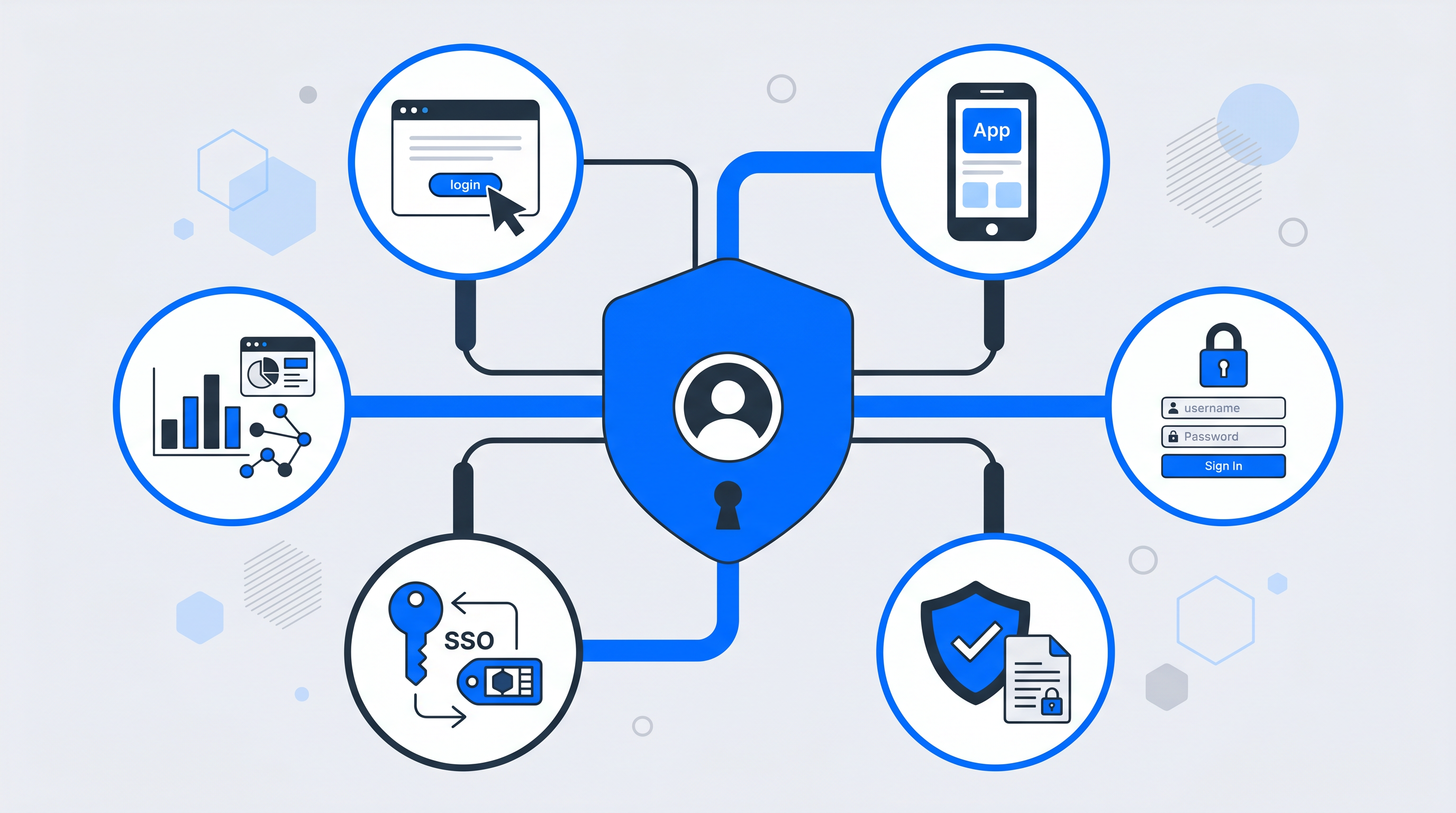
Customer Identity and Access Management (CIAM) is a framework of technologies that manages how external customers register, authenticate, and access your digital services—distinct from workforce identity systems that handle employee access.
Every login screen, registration form, and "forgot password" flow your customers encounter runs on CIAM infrastructure. This guide covers how CIAM works, what distinguishes it from traditional IAM, and how organizations use it to unify customer data, simplify compliance, and drive revenue growth.
What is CIAM
Customer Identity and Access Management (CIAM) is a set of technologies and processes that allows organizations to securely manage how external customers register, authenticate, and access digital services. While the acronym appears in other contexts—like architecture or education—in cybersecurity, CIAM refers specifically to managing the identities of people who use your public-facing websites, apps, and platforms.
Think of CIAM as the digital front door to your organization. It verifies who your customers are, remembers their preferences, and controls what they can access across all your services.
- Definition: CIAM stands for Customer Identity and Access Management, a framework for managing external user identities
- Primary purpose: Handling registration, login, and access for customers rather than internal employees
- Key distinction: Customer-facing identity management prioritizes user experience alongside security
Why is customer identity and access management important
With third-party cookies disappearing and privacy regulations tightening, organizations can no longer rely on external platforms to understand their customers. CIAM enables direct collection of zero-party data—information customers intentionally share—and first-party data, which is behavioral data you collect directly from interactions.
This shift toward owned data reduces dependence on big tech platforms while building more accurate customer profiles. At the same time, regulations like GDPR require organizations to manage consent carefully, and CIAM provides the infrastructure to do exactly that.
- Data ownership: Building your own customer database independent of third-party platforms
- Regulatory compliance: Meeting GDPR and other privacy requirements through built-in consent management
- Customer expectations: Delivering seamless experiences across websites, apps, and services
- Fraud prevention: Protecting customer accounts through modern authentication methods
How does CIAM work
A CIAM platform manages the complete customer identity lifecycle, from the moment someone first creates an account through every subsequent interaction with your digital services.
Registration and identity verification
The journey begins when a customer creates an account. CIAM platforms offer multiple registration options: traditional email and password, social login through providers like Google or Apple, or passwordless methods using email links or SMS codes. For scenarios requiring higher assurance, identity proofing can verify that customers are who they claim to be.
Authentication and Single Sign-On
Single Sign-On (SSO) allows customers to log in once and access multiple connected services without re-entering credentials. After initial authentication, the CIAM system issues tokens that prove the customer's identity to other applications. This eliminates the frustration of managing separate logins for each service.
Authorization and access control
Once authenticated, the system moves to authorization—determining what resources each customer can access. A basic subscriber might see free content, while a premium member unlocks exclusive features. Role-based access control (RBAC) assigns permissions based on customer segments or membership tiers.
Profile enrichment and data synchronization
CIAM continuously updates customer profiles with data from connected systems. When a customer makes a purchase, updates their preferences, or interacts with your content, that information flows into their central profile. Over time, this creates comprehensive 360° user profiles that power personalization across all touchpoints.
Key components of a CIAM platform
Understanding what makes up a CIAM solution helps when evaluating options or identifying gaps in a current setup.
Single Sign-On and unified login experience
SSO creates one login across all your digital properties. Standards like OpenID Connect (OIDC) and Security Assertion Markup Language (SAML) enable this interoperability, allowing your CIAM to communicate securely with any modern application.
Consent management and privacy controls
CIAM handles the collection, storage, and enforcement of user consent. Customers can see exactly what data you hold about them and control how it's used. This transparency builds trust while supporting GDPR compliance.
Customer profile and data management
Centralizing customer data into unified profiles enables personalization at scale. Rather than fragmented information scattered across systems, you get a single source of truth for each customer.
Multi-factor authentication and security
Multi-Factor Authentication (MFA) adds security layers beyond passwords. Customers might verify their identity through a code sent to their phone, a biometric scan, or a hardware token. This dramatically reduces account takeover risks.
Integration APIs and webhook support
Modern CIAM platforms connect to existing tech stacks through APIs and webhooks. These integrations synchronize customer data with CRMs, Customer Data Platforms (CDPs), e-commerce systems, and marketing tools.
Identity analytics and monitoring
Visibility into login patterns, registration trends, and potential security threats helps optimize the customer experience while catching suspicious activity early.
What is the difference between IAM and CIAM
This distinction trips up many organizations evaluating identity solutions. Traditional Identity and Access Management (IAM) serves internal users—employees, contractors, and partners. CIAM serves external customers.
| Dimension | IAM (Workforce) | CIAM (Customer) |
|---|---|---|
| Target users | Employees, contractors | External customers |
| User experience priority | Security-first | Balance of security and convenience |
| Scale requirements | Thousands | Millions |
| Data collection | Limited to job function | Rich profile and behavioral data |
| Self-service | IT-managed | User-managed |
| Compliance focus | Internal policies | Privacy regulations (GDPR, CCPA) |
Target user base
IAM manages people inside your organization who already have a relationship with you. CIAM manages anyone who might become a customer—people who will abandon a difficult registration flow in seconds.
User experience requirements
Employees tolerate friction because they have to. Customers don't. CIAM prioritizes smooth, fast experiences because every extra step costs conversions.
Data collection capabilities
While IAM stores job-related information, CIAM builds rich profiles including preferences, purchase history, content consumption, and consent records.
Self-service features
Customers expect to manage their own accounts—resetting passwords, updating preferences, and controlling privacy settings without contacting support.
Scalability demands
Your workforce might number in the thousands. Your customer base could reach millions, with unpredictable traffic spikes during sales events or product launches.
CIAM vs CRM
Both CIAM and Customer Relationship Management (CRM) systems store customer data, but they serve different purposes and work best together.
CIAM handles authentication, identity verification, consent management, and access control. CRM manages sales pipeline, customer interactions, marketing campaigns, and relationship history. The overlap is that both maintain customer records, but from different angles.
When integrated, CIAM feeds accurate, up-to-date customer information into your CRM. The CRM then uses this data for sales and marketing activities, confident that it reflects real, verified customers who have consented to communication.
Common CIAM use cases
Different industries leverage CIAM in ways that reflect their unique customer relationships.
Media and publishing platforms
Media brands use CIAM to unify reader identities across websites, mobile apps, newsletters, and podcasts. One login connects all content consumption, enabling personalized recommendations and streamlined subscription management.
Sports clubs and fan engagement
Sports organizations connect ticketing, merchandise, exclusive content, and membership programs under a single fan identity. This creates opportunities for targeted engagement and premium experiences.
Membership-based organizations
Associations and clubs manage member access to exclusive content, events, and benefits. CIAM handles tiered access levels and renewal workflows.
E-commerce and digital retail
Retailers use CIAM to streamline checkout, remember preferences, and personalize shopping experiences. Quick registration reduces cart abandonment while building valuable customer profiles.
Event and entertainment companies
Event organizers manage attendee registration, access control at venues, and post-event engagement through unified identities.
CIAM benefits for business growth
Beyond security, CIAM directly contributes to revenue and customer lifetime value.
Unified customer experience across all touchpoints
One login across all services reduces friction and increases engagement. Customers appreciate not managing multiple accounts.
Zero-party and first-party data ownership
Direct data collection from customers reduces dependence on third-party sources that are becoming less reliable and more restricted.
Simplified GDPR and regulatory compliance
Built-in consent management handles the complexity of privacy regulations, reducing legal risk and manual compliance work.
Lower IT costs through integration
Ready-to-go CIAM platforms with pre-built integrations eliminate the expense of custom identity development.
Higher revenue per user through personalization
Unified profiles enable targeted offers, premium membership upsells, and ID-based campaigns that increase revenue per customer.
CIAM security and compliance considerations
Protecting customer data requires multiple layers of security built into the CIAM platform.
Data encryption and protection
CIAM platforms encrypt data both at rest and in transit, ensuring customer information remains protected even if systems are compromised.
GDPR and privacy regulation support
Tools for consent collection, data subject access requests, and audit trails help organizations meet regulatory requirements—critical as cumulative GDPR fines exceed €7.1 billion.
EU data residency and hosting
For organizations serving European customers, EU-hosted CIAM solutions simplify GDPR compliance by keeping data within approved jurisdictions.
Fraud prevention and threat detection
Risk-based authentication evaluates login attempts for suspicious patterns, with ATO losses surpassing $15.6 billion in the U.S. in 2024. Anomaly detection catches account takeover attempts before damage occurs.
CIAM implementation challenges and how to solve them
Knowing common obstacles helps when planning for successful deployment.
Migrating data from legacy identity systems
Consolidating user data from multiple silos requires careful user matching and deduplication. CIAM platforms with built-in migration tools simplify this process considerably.
Balancing security with frictionless user experience
Strong authentication can frustrate customers. Progressive security—adding verification steps only when risk indicators appear—maintains both security and convenience.
Integrating CIAM with existing tech stacks
APIs and webhooks connect CIAM to CRMs, CDPs, and other systems. Standards-based platforms using OIDC and SAML integrate more easily with existing infrastructure.
Handling traffic spikes and scale
Unpredictable load during peak events requires infrastructure that scales automatically without degrading performance.
Best practices for CIAM implementation
Following proven approaches increases the chances of success.
1. Define your customer identity management strategy
Start with business goals. What data do you need? Which touchpoints connect? What customer experience do you want to deliver?
2. Design for user experience first
Prioritize low-friction registration and login. Consider social login options, progressive profiling that collects data gradually, and passwordless authentication—especially given over 16 billion passwords compromised worldwide.
3. Choose standards-based integration
Select CIAM solutions supporting OIDC and SAML for interoperability with current and future systems.
4. Implement progressive profiling
Collect minimal data at registration, then enrich profiles over time. This reduces abandonment while still building comprehensive customer records.
5. Build compliance into the foundation
Configure consent management, data retention policies, and audit capabilities from the start rather than retrofitting later.
How to choose the right CIAM solution
Evaluating CIAM platforms requires examining several key factors.
OpenID Connect and SAML standards support
Standards compliance ensures your CIAM connects with any modern application without custom development.
Integration ecosystem and API flexibility
Evaluate both pre-built integrations and the flexibility of the User API for custom requirements.
Branding and customization options
Assess whether the platform allows branded login screens, user account management interfaces, and configurable data fields that match your brand identity.
Data residency and compliance certifications
Consider where customer data will be hosted and what compliance certifications the provider maintains.
Total cost and time to value
Evaluate both pricing and implementation timeline. Ready-to-go solutions with extensive integrations typically deliver value faster than custom development.
How CIAM turns customer identity into digital growth
CIAM represents more than a security tool—it's the central layer connecting data silos, improving user experience, and enabling monetization. Organizations that treat customer identity as a strategic asset gain advantages in personalization, compliance, and customer lifetime value.
Moving beyond fragmented logins to a unified identity strategy creates opportunities for premium memberships, partner integrations, and ID-based campaigns. The result is stronger customer relationships built on trust, convenience, and value exchange.
What does CIAM stand for in cybersecurity?
CIAM stands for Customer Identity and Access Management, referring to technologies and processes that securely manage how external customers register, authenticate, and access an organization's digital services.
How does CIAM support zero-party data collection?
CIAM collects data directly from customers through registration forms, preference centers, and consent-driven interactions. This gives organizations owned data that doesn't rely on third-party tracking or cookies.
Can CIAM replace a cookie consent management platform?
CIAM includes consent management features for user permissions and data preferences. However, organizations may still benefit from a separate cookie consent tool for website tracking compliance, depending on specific requirements.
What is the difference between CIAM and a CDP?
CIAM manages identity, authentication, and consent while a Customer Data Platform (CDP) aggregates and analyzes customer data from multiple sources. They work together—CIAM feeds verified identity data into the CDP for analysis and activation.
How long does a typical CIAM implementation take?
Implementation timelines vary based on complexity. Ready-to-go CIAM platforms with pre-built integrations can launch in weeks, while custom-built identity solutions often take months or longer.
Is CIAM software suitable for small and mid-sized businesses?
Modern CIAM platforms offer scalable pricing and ready-to-go configurations that make customer identity management accessible to organizations of all sizes.
::
What Is a White-Label Solution and Its Benefits?
Unidy is a White-Label Identity Solution. But what does that actually mean and what are the advantages of a white-label solution?
What is our multibrand feature?
This blog article explains our multi-brand feature and its key benefits. The feature allows organizations a centralized user account for different brands enabling the synchronisation of data across brands. Every brand is designed individually and includes different services, channels and subscriptions.