

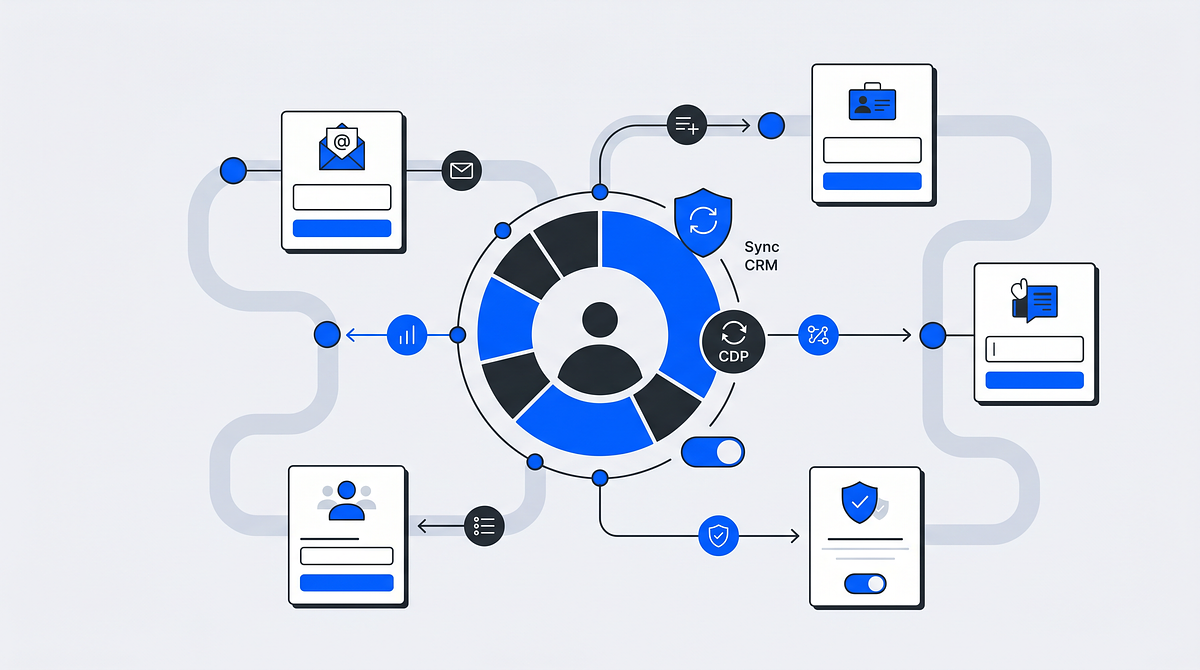
Long registration forms are conversion killers. When users see 10 fields standing between them and your content, most leave.
Progressive profiling takes a different approach: instead of asking for everything upfront, you collect customer data gradually across multiple interactions. A user shares their email address today, their job title next week, and their preferences after the third visit. This article explains how progressive profiling works, which data to collect at each stage of the customer journey, and how to build the infrastructure that makes step-by-step data collection possible.
What is progressive profiling?
Progressive profiling is a data collection method where customer information is gathered gradually across multiple interactions instead of all at once. Rather than showing a 10-field form during registration, you first ask only for an email address. On the next visit, you ask for a job title. After a purchase, you ask for preferences. Each touchpoint adds one or two more data points to the user’s profile.
The core idea is simple: shorter forms get completed more often — 27% cite form length as a reason for abandonment. Progressive profiling avoids this problem by spreading data requests across the full customer relationship.
Long forms don't just annoy users — they kill the data you're trying to collect
Over time, this approach creates richer profiles than traditional forms ever could. A user who would never complete a 15-field registration may happily answer 15 individual questions if they are asked over the course of several months.
How does progressive profiling work?
Progressive profiling works because several technical building blocks operate together. Once you understand how each component functions, it becomes clearer why step-by-step data enrichment works in practice.
Smart forms and dynamic form fields
Smart forms check which data already exists in a user’s profile before showing any fields. If someone shared their email address last week, the form this week can ask a different question, such as industry or content preferences.
Dynamic form fields make this possible. The form logic checks the user’s existing profile and then renders only the fields that are still missing. Users never see the same question twice, and every interaction feels relevant to their current stage in the relationship.
Behavioral and event-based triggers
Data requests work best when they appear at the right moment. Behavioral triggers prompt requests based on specific user actions.
Examples include:
- A user downloads their third whitepaper, and the form asks for their role
- Someone completes a first purchase, and a follow-up request asks for size preferences
- A visitor returns for the fifth time, and a prompt asks about their interests
When data collection is tied to moments of high engagement, completion rates tend to improve because users are already invested in the interaction.
Central user profile and data storage
Progressive profiling requires a central place where all collected data is stored. Without a unified user profile, information gathered at different touchpoints stays fragmented across multiple systems.
An identity management layer provides the foundation for this. It maintains one record per user and accumulates data from every interaction, regardless of which service or channel captured it.
Sync with CRM, CDP, and marketing tools
Collected data only becomes valuable when it reaches the systems that can act on it. Progressive profiling implementations typically sync with CRM systems, customer data platforms, and marketing automation tools.
If a user shares preferences on your website, that information should flow into your email platform, ad targeting system, and your sales team’s CRM. Without this synchronization, progressive profiling generates data that goes unused.
Why is progressive profiling important for customer data growth?
Progressive profiling affects four outcomes directly tied to revenue and customer relationships:
- Lower abandonment rates: users complete shorter forms more often. A 3-field form converts better than a 10-field one.
- Higher data accuracy: when you ask for information in the right context, users give more thoughtful answers. Asking about content preferences after someone explores your library produces better data than asking the same question during first registration.
- More complete profiles: gradual collection builds richer user profiles over time. Each interaction adds another layer of understanding.
- More trust: asking for data progressively signals respect for users’ time. That builds trust and increases the likelihood that they will share more information later.
How to map progressive profiling to the customer journey
The real value of progressive profiling comes from matching data requests to each stage of the journey. Here is how that alignment typically works.
Step 1: Anonymous visitor and first touch
At this stage, you know nothing about the visitor. The goal is to turn them into a known user with as little friction as possible.
Collect only the minimum necessary information: an email address, and maybe a name. Some companies skip forms entirely here and rely on behavioral data until the user takes a higher-intent action, such as starting a download or beginning a purchase.
Step 2: Registration and account creation
When a user creates an account, the initial form should stay short. Email and password are often enough. A name field can also make sense. Everything beyond that can wait.
The temptation is to ask for everything now. Resist it. Users who abandon long registration forms are lost opportunities that follow-up emails rarely recover.
Step 3: Active usage and returning users
When users come back and engage through purchases, content consumption, or feature usage, you earn the right to ask for more.
Request data that is relevant to what they are doing. If someone repeatedly browses your product catalog, ask about preferences. If someone attends a webinar, ask about their role or challenges. Context makes requests feel helpful instead of intrusive.
Step 4: Loyalty, membership, and premium conversion
In high-trust stages, users are more willing to share detailed information when they receive clear value in return.
Premium membership sign-ups, loyalty program enrollment, or requests for personalized services are strong moments to collect payment details, detailed preferences, or broader profile data. The value exchange is obvious: users share more because they get more.
What types of customer data can you collect progressively?
Progressive profiling typically gathers four categories of customer data. Each has different characteristics and an ideal moment for collection.
| Data type | Definition | Example | When to collect |
|---|---|---|---|
| Zero-party data | Information users intentionally share | Product preferences, interests | After the first interaction |
| First-party behavioral data | Observed interaction data | Viewed pages, purchases | Continuously, passively |
| Demographic data | Profile attributes | Location, professional role | During registration and follow-up |
| Consent data | Permissions and preferences | Marketing opt-ins | At registration, then update regularly |
Zero-party data
Zero-party data refers to information that users proactively and intentionally share. Product preferences, stated interests, and purchase intent all fall into this category.
Because users provide this data consciously, it is usually precise and directly useful for personalization, which 71% of consumers now expect. Progressive profiling is especially well suited for collecting zero-party data because preferences can be asked at the exact moments when users are already engaging with those topics.
First-party behavioral data
First-party data comes from observing user interactions on your own platforms. Browsing behavior, purchase history, content consumption, and feature usage all fall into this category.
Unlike zero-party data, first-party behavioral data is collected passively. Progressive profiling complements it by filling in gaps that behavior alone cannot explain, such as why someone is looking at certain products or what they plan to do next.
Demographic and profile data
Standard profile fields such as location, job title, and company size help complete the customer picture. When demographic questions are spread across multiple touchpoints, they avoid the interrogation feeling that long forms often create.
Consent and preference data
Capturing and managing user consent is both a legal requirement under regulations like the GDPR and a trust-building practice.
Progressive profiling includes consent collection as part of the data gathering process. Each new data request can include relevant consent options, and preference centers allow users to update their choices over time.
Best practices for progressive profiling
Effective progressive profiling balances data collection goals with user experience. A few core principles help.
Keep first registration short
Limit the initial registration to truly necessary fields. Email and password are often enough. The goal of registration is conversion, not comprehensive data collection.
Only ask for relevant data in the right context
Request data that matches the user’s current activity. Asking for job title during a content download can make sense. Asking the same question during a newsletter sign-up can feel disconnected.
Tie every data request to a clear user benefit
Users share data when they understand what they get in return. “Tell us your industry so we can send you relevant case studies” works better than “Please complete your profile.”
Integrate progressive profiling with single sign-on
Single sign-on (SSO) creates a central identity layer where progressive profiling data can accumulate across all touchpoints. When users log in once and access multiple services, each service can contribute to and benefit from the unified profile.
Respect consent and GDPR requirements
Every data request is an opportunity to demonstrate transparent data practices. Offer clear consent options, explain how data will be used, and make sure users can access and manage their information through a central interface.
Common progressive profiling challenges and how to solve them
Progressive profiling is not without challenges. Here are common problems and practical ways to address them.
Form abandonment and user friction
Even short forms can create drop-off if they appear at the wrong moment or ask for sensitive information too early. Testing form length and timing helps identify what works best for your audience. Progress indicators and an immediate visible benefit after submission can further reduce friction.
Fragmented data across silos
When progressive data is collected in separate systems such as your website, mobile app, and customer service platform, profiles remain incomplete unless those systems communicate.
A central identity layer solves this by bringing data from all sources into a single user profile. This is where identity management platforms shift from optional tools to essential infrastructure.
GDPR compliance and consent risk
Collecting data without proper consent creates legal risk — GDPR fines now exceed €7.1 billion — and weakens user trust. Transparent consent management with clear opt-in flows for every data request addresses both concerns. A central place where users can review and manage their data and permissions supports compliance and strengthens trust.
Consent isn't just about trust — non-compliance carries measurable financial risk
When progressive profiling is not the right approach
Progressive profiling works best in ongoing relationships with repeated interactions. It is less suitable for one-time transactions, situations where regulations require complete data collection upfront, or low-engagement business models where users rarely return.
Building a central identity layer for progressive profiling
Progressive profiling requires infrastructure that can store, manage, and sync user data across touchpoints. Without a central identity layer, data stays scattered and the benefits of gradual collection disappear.
An identity management platform provides that foundation. It maintains unified user profiles, manages consent, and connects with downstream systems like CRMs, CDPs, and marketing tools. When a user shares information in one connected service, that data flows into the central profile and becomes available everywhere it is needed.
For organizations operating multiple digital services, a branded user account with a central data and consent cockpit gives users transparency into what they have shared and control over their preferences. That transparency supports both GDPR compliance and the trust needed to make progressive profiling effective over time.
Frequently asked questions about progressive profiling
How is progressive profiling different from traditional customer profiling?
Traditional customer profiling gathers all data at once, typically through long registration forms. Progressive profiling collects data gradually across multiple interactions, reducing friction and improving completion rates.
What are the four categories of customer data?
The four categories are zero-party data, first-party data, second-party data, and third-party data. Progressive profiling focuses mainly on collecting zero-party and first-party data.
Is progressive profiling GDPR compliant?
Yes, if it is implemented with transparent consent management. Each data request should include clear consent options, and users should be able to review and manage their data and permissions through a central interface.
How does progressive profiling work with single sign-on?
Single sign-on creates a central user identity across connected services. Progressive profiling builds on top of that by enriching the central profile over time as users interact across touchpoints, allowing each service to contribute to and benefit from unified data.
Die Preußen-ID: In sechs Wochen vom Konzept zu knapp 100.000 Fans
Im Februar 2026 hat SC Preußen Münster die Preußen-ID eingeführt – eine einheitliche Fan-Identität, die heute knapp 100.000 Nutzer und eine sechsstellige Anzahl an Opt-ins in einem Profil zusammenführt. Das Mitglieder-Onboarding läuft seither automatisiert. Manuelle Listenpflege entfällt.
SAML vs. OIDC: Bestes Protokoll für Ihr Unternehmen
Was sind SAML (Security Assertion Markup Language) und OIDC (OpenID Connect)? Beide sind Authentifizierungsprotokolle, die einen Single Sign-On (SSO) ermöglichen. Welches eignet sich besser für Ihr Unternehmen? Wir stellen Ihnen beide Protokolle vor, wie sie arbeiten, was sie auszeichnet und welches für Ihr Unternehmen am besten geeignet ist.