

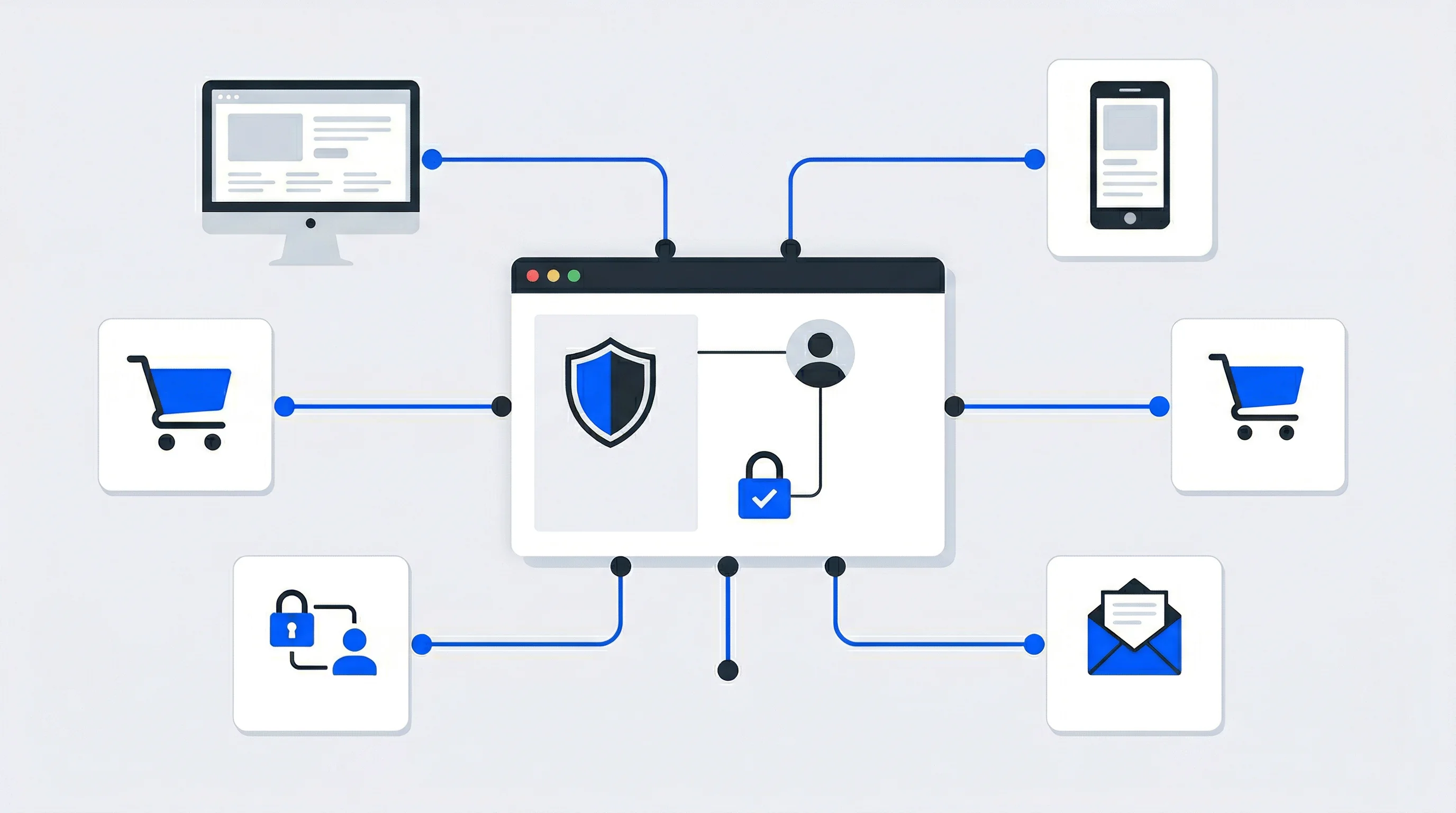
Organizations managing multiple digital properties face a structural identity problem: fragmented authentication systems, fractured user data, and dependency on platforms that own the user relationship. White-label identity management resolves this with a fully rebrandable IAM platform—deployed under your brand, backed by enterprise infrastructure, and built to turn identity into a business asset.
What Is White-Label Identity Management?
White-label identity management is a pre-built identity and access management (IAM) platform that organizations rebrand and deploy as their own product. The technology provider builds and operates the infrastructure, handles security, and manages compliance. The deploying organization applies their brand—logos, colors, typography, custom domains—across every user-facing touchpoint. The vendor remains invisible to users.
Two concepts converge in this model:
- White label: A production-ready product manufactured by one company and marketed under another's brand
- Identity management: Systems governing authentication, user profile data, access rights, and consent across digital services
This differs fundamentally from building custom identity infrastructure—typically months of work requiring specialists in cryptography, token management, and compliance frameworks—and from social login providers like "Sign in with Google," where the third party's branding stays visible and they retain control over the user relationship.
Why It Matters for Digital-First Organizations
Modern organizations operate multiple digital touchpoints simultaneously: websites, mobile apps, e-commerce platforms, membership portals, newsletters. Without a unified identity layer, each becomes an isolated data silo with its own login system and fragmented user information.
White-label identity management creates a single, coherent identity that spans all digital properties. A media company connects their news site, podcast platform, and subscription service under one login. Users authenticate once and move freely across services.
Three structural drivers make this strategically relevant:
- Data ownership: Organizations control user data directly, without delegating it to platforms that monetize it for their own purposes
- First- and zero-party data: As third-party cookies are phased out, intentionally shared preferences (zero-party) and direct interaction data (first-party) become the primary growth assets
- Consistent experience: A unified login reduces friction and builds trust across the entire brand portfolio
Business Benefits
Complete Brand Control
Every element in the identity flow—login screens, password reset emails, account settings, consent forms—displays only your brand. Custom domain support ensures users never leave your branded environment, even during authentication. Trust builds with your organization, not with an underlying technology vendor users have never encountered.
Full Ownership of User Data
When accounts are created and preferences shared through your white-label platform, that data belongs to your organization. You define how it is used, which downstream systems receive it, and how long it is retained. No intermediary extracts value from your user relationships.
This structural independence from Big Tech ecosystems grows more important as privacy regulations tighten and platform policies shift unpredictably.
Reduced Costs and Faster Time-to-Market
Secure identity infrastructure requires deep expertise in cryptography, token standards, security protocols, and compliance frameworks. White-label platforms provide all of this out of the box. Deployment typically takes weeks rather than the months required for custom builds. Pre-built integrations with CRM and marketing platforms accelerate implementation further.
Higher Conversion Rates
Single Sign-On (SSO) lets users authenticate once and access all connected services without re-entering credentials. Fewer login prompts directly reduce abandonment: Zuko data shows password fields carry a 10.5% abandonment rate. When login, consent collection, and checkout flow together without interruption, registration and purchase conversion rates improve measurably.
Built-In Compliance and Consent Management
GDPR mandates transparent consent collection and user rights to manage personal data. With DLA Piper reporting €5.88 billion in cumulative GDPR fines, non-compliance carries substantial financial risk. Purpose-built white-label identity platforms include consent management as a core capability—no bolt-on compliance tooling required.
Core Features to Evaluate
| Feature | What it does | Business value |
|---|---|---|
| Branded login screens | Customizable UI: logo, colors, typography, custom domain | Consistent brand experience |
| SSO with OIDC/SAML | Single authentication across all connected services | Reduced login friction |
| API and webhooks | Real-time data exchange with external systems | Tech stack flexibility |
| Centralized profiles | Unified user data from all touchpoints | 360° customer view |
| Consent management | Granular opt-in controls with full audit trail | GDPR compliance |
Branded Login Screens and Account Cockpit
Look for customization depth beyond logo placement: full control over colors, typography, layout, button styles, and custom domain routing. A self-service account cockpit lets users manage data, consent settings, and preferences in one branded location—reducing support overhead while reinforcing trust.
Single Sign-On with OIDC and SAML
OpenID Connect (OIDC) and SAML are the industry standards for federated authentication. OIDC suits modern web and mobile applications; SAML remains prevalent in enterprise environments. Support for both ensures your identity layer connects with virtually any service—cloud applications, legacy systems, or partner platforms.
API Access and Webhooks
REST APIs enable programmatic interaction between your systems and the identity platform. Webhooks extend this with real-time event notifications—profile updates, consent changes, login activity. Together, they enable a best-of-breed architecture where identity integrates into existing tooling rather than forcing platform consolidation.
Centralized User Profiles and Data Synchronization
A 360° user profile aggregates data from all connected touchpoints into one unified record. Purchases, event attendance, content engagement, preference updates—all flow into a single profile. Continuous sync with CRMs, CDPs, and integration platforms keeps this data current across the entire stack.
Configurable Consent Management
Enterprise consent management requires granular opt-in controls per data use case, plain-language consent screens, and audit-ready records documenting what users agreed to and when. EU-hosted infrastructure addresses data residency requirements for organizations operating under GDPR.
Which Organizations Benefit Most
Media Brands and Publishers
Publishers often manage multiple properties—news sites, lifestyle brands, podcasts, newsletters—each potentially with separate login systems. A unified identity layer connects these properties, enables personalized content recommendations, and supports subscription and newsletter management across the portfolio.
Sports Clubs and Entertainment Organizations
Fan engagement spans ticketing, merchandise, memberships, mobile apps, and stadium experiences. A purpose-built identity platform connects these touchpoints so organizations can recognize fans across every channel and deliver consistent, personalized experiences.
Membership-Based Businesses
Organizations offering tiered memberships need identity solutions that support granular access controls, premium content gating, and personalized member journeys. The identity layer becomes the foundation for upgrade flows and exclusive offerings.
Multi-Property Platforms and Agencies
When multiple brands operate under one corporate umbrella, multibrand identity capability lets each maintain distinct branding while sharing common authentication infrastructure. Agencies can offer identity management as a fully branded, value-added service for clients—without building infrastructure from scratch.
How White-Label Identity Management Works
Authentication Flow and Token Management
When a user logs in, the platform verifies credentials and issues a JSON Web Token (JWT) containing encoded identity and permission data. Connected services validate this token without requiring re-authentication. Tokens have defined lifespans and refresh automatically to maintain secure sessions.
Progressive Profile Enrichment
Registration creates a central user profile. Subsequent interactions across connected services—purchases, event attendance, content consumption, preference updates—enrich this record over time without requiring lengthy upfront forms. Progressive profiling builds complete user understanding incrementally.
Integration Architecture
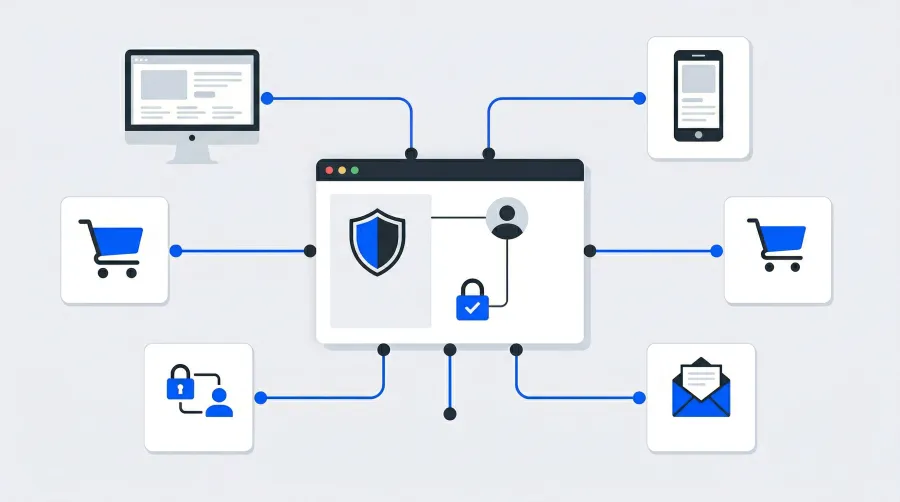
The identity layer operates as a hub: pushing data to CRMs, recognizing authenticated users on e-commerce platforms, and distributing consent preferences to marketing tools. Profile changes and consent modifications propagate to connected systems automatically — SCIM can extend this with standardized user provisioning across the stack.
Integration Approaches
Pre-Built Connectors
Most platforms offer ready-made integrations for Salesforce, HubSpot, Segment, and other common tools, typically requiring only API credentials and field mapping to activate.
Custom REST API Implementation
Organizations with specific UX requirements or complex existing systems can use REST APIs to build custom front-end experiences while leveraging the platform's backend identity capabilities—preserving full design freedom without rebuilding authentication infrastructure.
Webhooks for Real-Time Synchronization
Webhooks trigger automated downstream actions on specific events: a profile update syncs instantly to the CRM; a consent withdrawal updates marketing suppression lists immediately. Real-time synchronization eliminates batch processing delays and manual reconciliation.
Implementation Roadmap: Deploying White-Label SSO
Deploying white-label SSO requires systematic planning across technical implementation, brand configuration, and user migration. Success depends on early identification of data sources, stakeholder alignment, and phased rollout strategies that minimize disruption while maximizing adoption.
Phase 1: Discovery and Planning
Begin with comprehensive data mapping across existing systems. Document all current login methods, user databases, permission structures, and integration points. Identify which systems will connect to SSO immediately versus in later phases. Define brand requirements: logo usage, color schemes, typography, custom domain setup, and email template specifications. Establish success metrics for user adoption, conversion rates, and technical performance.
Phase 2: Platform Configuration and Branding
Configure the white-label identity platform with your complete brand identity. This includes login screen customization, email templates, account cockpit styling, and custom domain configuration. Set up user data fields that match your existing customer data structure. Configure consent management screens with your privacy policy language and opt-in requirements. Establish OIDC or SAML connections for your first integration targets—typically starting with the highest-value services that benefit most from reduced login friction.
Phase 3: User Migration and System Integration
Execute user data migration from existing systems to the central identity platform. This process includes data cleansing, duplicate removal, and profile matching across multiple data sources. Implement real-time synchronization with your CRM, marketing automation, and other key systems through APIs and webhooks. Configure access controls and user group definitions that reflect your business requirements—premium members, regional access, content tiers, or partner-specific permissions.
Phase 4: Rollout and Optimization
Begin with a limited rollout to a subset of users or services to validate the implementation. Monitor authentication success rates, user experience feedback, and system performance under real-world conditions. Once validated, expand SSO to additional services progressively. Implement user communication campaigns explaining the simplified login experience. Continuously optimize based on usage patterns—simplifying consent flows, adjusting profile field requirements, and expanding integration coverage based on business priorities.
Compliance and Security
GDPR and EU Data Hosting
Data residency—the physical location where data is stored—matters for regulatory compliance. EU-hosted infrastructure simplifies GDPR compliance and satisfies data residency requirements for organizations serving European users without contractual workarounds.
Consent Records and Auditability
Compliant consent management requires documented records of what users agreed to, when, and through which interface. Plain-language consent screens build user trust while meeting regulatory accountability standards.
Security Certifications
ISO 27001 or SOC 2 should be baseline requirements. Core practices include encryption at rest and in transit, secure token handling, and independently conducted security audits.
How to Choose a Provider
- Branding depth: Full control over screens, emails, user portals, and custom domain configuration
- Protocol support: Both OIDC and SAML for broad interoperability across modern and legacy systems
- Integration breadth: Pre-built connectors, robust REST API, real-time webhook capability
- Data portability: Straightforward export mechanisms and clear contractual terms governing data after contract termination
- Compliance infrastructure: EU data hosting and comprehensive consent management as built-in capabilities
- Scalability: Architectural capacity to grow with your user base without performance degradation
Tip: Request access to a demo environment specifically to test branding customization and integration depth before committing. The actual depth of customization varies significantly between vendors and is rarely fully apparent from documentation or sales conversations alone.
Market Landscape: Key White-Label Identity Providers
The white-label identity management market includes both enterprise-focused platforms and specialized solutions for digital-first organizations. Enterprise platforms like Okta, Ping Identity, and Microsoft Entra ID offer comprehensive identity governance with white-label capabilities, typically suited for large organizations with complex IT requirements and existing identity infrastructure.
Specialized platforms focus specifically on white-label deployment for digital businesses. Auth0 provides developer-friendly identity services with extensive customization options. FusionAuth offers a complete identity platform designed for application developers. Keycloak delivers open-source identity management with self-hosted or managed deployment options.
Growth-oriented platforms like Unidy combine white-label identity management with marketing and revenue features specifically designed for media brands, sports organizations, and membership businesses. These platforms emphasize not just authentication but data ownership, consent management, and monetization capabilities that turn identity infrastructure into a business asset.
When evaluating providers, consider both current technical requirements and strategic business objectives. Enterprise-grade security and compliance should be universal, but the balance between technical depth and business functionality varies significantly across platforms.
Identity as a Growth Engine
Identity infrastructure does not have to be a cost center. When user profiles, consent data, and authentication flow through a central platform, commercial opportunities emerge directly from the data layer. McKinsey research shows personalization drives a 10 to 15 percent revenue lift—making unified identity data a direct revenue contributor, not just IT overhead.
Premium membership tiers can be gated by identity. ID-based marketing campaigns can target specific user segments with personalized offers — learn more in how companies increase digital sales with Unidy. Partner integrations extend reach while preserving data ownership.
Platforms like Unidy approach white-label identity management with this commercial orientation—combining SSO, consent management, and 360° user profiles with features designed to drive revenue per user. The identity layer becomes not just infrastructure, but the foundation for sustainable digital growth independent of Big Tech ecosystems.
Frequently Asked Questions
What is white-label authentication?
White-label authentication is the login and verification component of a broader identity management system, fully rebranded with your organization's visual identity. Users see only your brand throughout sign-in—no third-party logos or generic login interfaces appear.
How does white-label identity management differ from identity verification?
Identity management handles ongoing authentication, user profile maintenance, and access control across digital services. Identity verification (IDV) is a one-time process confirming a user's real-world identity through document checks, biometrics, or database lookups. Most organizations use both: IDV during initial onboarding, identity management for ongoing access.
Can existing users be migrated to a white-label platform?
Yes. Most platforms support structured migration of existing user records, profile deduplication, and credential preservation so users do not need to re-register. Migration complexity depends on the quality and structure of source system data.
How long does implementation typically take?
Pre-built platforms with standard integrations can be deployed in weeks. Custom integrations or complex migrations extend this timeline. Organizations replacing legacy custom-built identity infrastructure typically achieve the fastest time-to-value with a white-label approach.
What technical resources are required for implementation?
Most white-label platforms require minimal development resources for standard implementations. Basic integration typically involves configuring OIDC or SAML connections, setting up webhooks, and mapping data fields—tasks that existing development teams can handle. Complex custom integrations or extensive API usage may require specialized identity management expertise, though significantly less than building custom infrastructure from scratch.