

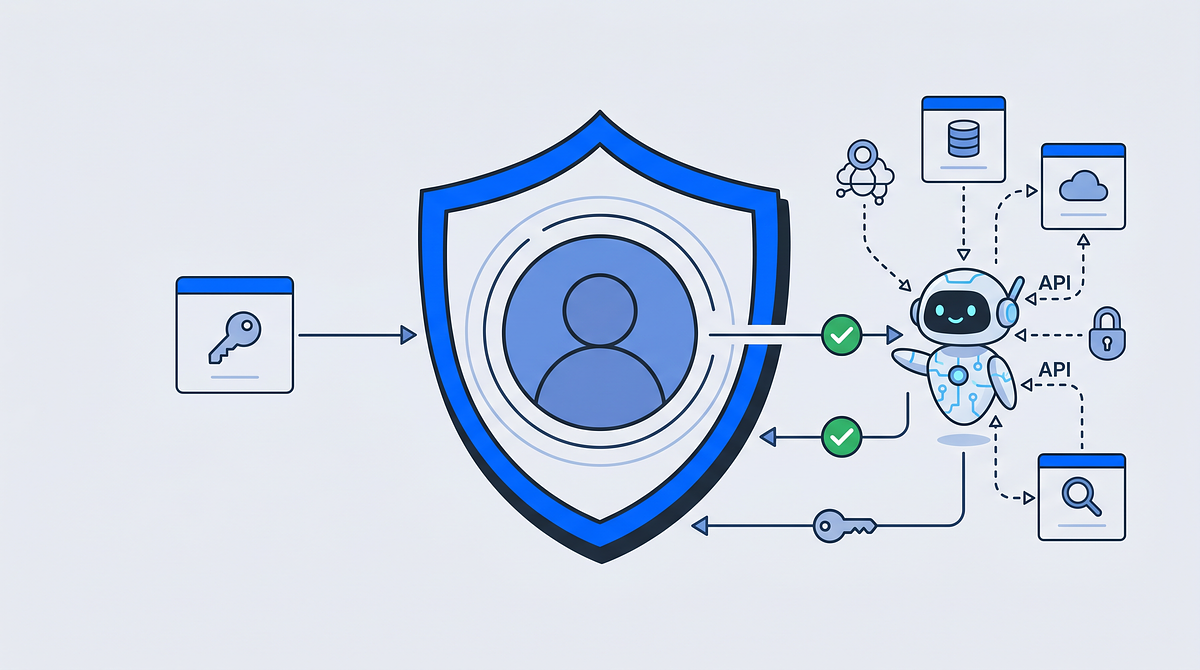
From Identity to Intelligence: How CIAM Powers AI Enablement
AI agents are already retrieving customer data, completing transactions, and personalizing experiences across digital services. The question is whether your identity infrastructure can tell the difference between a legitimate AI assistant acting on behalf of a user and an unauthorized system attempting to access sensitive information.
CIAM AI enablement addresses this gap by extending Customer Identity and Access Management beyond human users to include the AI agents, bots, and automated systems that increasingly interact with customer data. This article covers what CIAM AI enablement means, why traditional identity systems fall short, and how to build the authentication, authorization, and consent foundations that secure AI workloads.
What is CIAM AI enablement
Customer Identity and Access Management (CIAM) AI enablement means integrating artificial intelligence capabilities into the systems that manage how customers register, log in, and access digital services. Instead of relying on fixed rules, AI-enabled CIAM uses dynamic, behavior-based security. Think continuous risk scoring, biometric authentication, and adaptive access decisions that respond to context in real time.
There is another dimension to CIAM AI enablement that often gets overlooked. When an AI assistant retrieves personal data or completes a transaction on behalf of a user, something has to verify that the AI is allowed to do that. CIAM provides the identity credentials, authorization scopes, and consent records that make secure AI interactions possible.
- CIAM: A system that manages customer identities, authentication, and authorization across digital services
- AI enablement: Providing the identity and permission layer that AI systems require to access data and perform actions on behalf of users
Why traditional CIAM falls short for AI workloads
Legacy CIAM was built for humans clicking through interfaces. A person enters a username and password, maybe completes a second factor, then browses within a session that expires after some period of inactivity. The whole model assumes someone is sitting at a screen.
AI agents work differently. They make API calls at high volume, act autonomously without a human present, and require machine-readable credentials rather than interactive login screens. When organizations try to connect AI systems to existing identity infrastructure, the mismatch becomes obvious.
| Characteristic | Traditional CIAM (human users) | AI-ready CIAM (agents and NHIs) |
|---|---|---|
| Interaction model | Point-and-click UI | API calls and prompts |
| Authentication | Username/password, MFA | OAuth tokens, client credentials |
| Session duration | Short-lived browser sessions | Long-running or scheduled tasks |
| Consent model | One-time user approval | Scoped, purpose-bound delegation |
| Scale | Thousands of logins per day | Millions of API requests per day |
How AI agents and non-human identities change the CIAM model
When AI systems interact with customer data, they introduce a new category of identity. CIAM platforms that want to support AI workloads have to recognize and manage identities that are not human.
Human users versus non-human identities
Non-Human Identities (NHI), which now outnumber human identities 144 to 1, is the term for AI agents, bots, and service accounts that require their own identity records. A human logs in once and interacts with an application directly. An AI agent, on the other hand, might call APIs continuously over hours or days without anyone present.
NHIs require their own credentials, lifecycle management, and audit trails. The records stay separate from the user who authorized the agent, though the two remain linked through a chain of trust.
Delegated authority and acting on behalf of users
When a user authorizes an AI assistant to retrieve personal data or complete a transaction, the CIAM system records who delegated what permissions to which agent. This concept of delegation sits at the center of AI enablement.
OAuth 2.0 token exchange provides the technical mechanism. The user grants consent, the CIAM system issues a scoped token to the AI agent, and that token limits exactly what the agent can do. If the user revokes consent, the token becomes invalid immediately.
Core CIAM capabilities that power AI enablement
Several specific features distinguish a CIAM platform that can support AI workloads from one that cannot. Here is what to look for.
Identity for AI agents and service accounts
AI agents require their own identity records in the CIAM system, separate from human users. Each agent receives a unique client ID and secret, allowing the system to track which agent performed which action.
Fine-grained authorization and scoped tokens
Scoped tokens limit what actions an agent can perform. "Read user profile" is different from "modify payment method." Fine-grained authorization ensures an AI recommendation engine can access preferences without being able to change billing details. According to Entro Security research, 97% of NHIs have excessive privileges, making scoped tokens essential.
Consent capture and purpose binding
CIAM records explicit user consent for AI to access specific data for a specific purpose. This is where zero-party data collection (information users proactively provide) ties directly into AI enablement. Without recorded consent, AI systems cannot lawfully process personal data under regulations like GDPR.
Audit logging and observability
Every action an AI agent takes gets logged with the agent ID, user ID, timestamp, and action performed. This supports compliance requirements and makes troubleshooting straightforward when something goes wrong.
Lifecycle management for non-human identities
AI agent credentials require rotation, revocation, and retirement. When an integration is removed, orphaned credentials become a security risk. Lifecycle management ensures credentials are deactivated when no longer needed.
Authentication and authorization for AI agents with OAuth and OpenID Connect
Industry standards provide the foundation for secure AI agent authentication. Here are the key protocols:
- OAuth 2.0: An authorization framework that issues access tokens with specific scopes
- OpenID Connect (OIDC): An identity layer on OAuth that provides user identity information via ID tokens
- Client credentials grant: The OAuth flow where an AI agent authenticates with its own credentials rather than a user's
For machine-to-machine communication, the client credentials grant is the typical approach. The AI agent presents its client ID and secret, receives an access token, and uses that token to call APIs. OIDC adds identity claims when the system also has to know which user authorized the agent.
SAML (Security Assertion Markup Language) remains relevant for legacy systems, though OAuth and OIDC are more common for modern AI integrations.
Use cases for CIAM AI enablement across digital services
Concrete examples help illustrate how CIAM AI enablement works in practice across different scenarios.
AI personalization and recommendations
An AI recommendation engine requires read access to user preferences and behavior data. CIAM ensures the AI only accesses data the user has consented to share. The scoped token prevents the engine from modifying any records.
AI chatbots and conversational assistants
A support chatbot retrieving user account details authenticates through the CIAM system. The chatbot receives authorization to access specific profile fields, such as order history, while being blocked from sensitive data like payment methods.
Agent-driven checkout and membership flows
An AI assistant completing a purchase on behalf of a user requires elevated permissions. CIAM can enforce step-up authentication or request additional consent before payment actions proceed.
ID-based campaigns and audience activation
AI systems selecting users for marketing campaigns query the identity data hub. CIAM ensures only opted-in users are included, respecting consent preferences stored in user profiles.
A phased roadmap to implement CIAM AI enablement
Organizations typically approach AI enablement in stages rather than all at once. Here is a practical sequence.
Step 1. Establish a central identity foundation
First, consolidate user identities into a single system with unified login through Single Sign-On (SSO). Migrate data from silos and establish central user IDs. This foundation is the prerequisite before AI can be enabled, because AI systems require a single source of truth for user data and consent.
Step 2. Add agent identity and fine-grained authorization
Next, register AI agents as NHIs in the CIAM system. Define scopes and permissions for each agent. Implement OAuth client credentials and connect agents via API and webhooks.
Step 3. Operationalize governance and production controls
Finally, implement audit logging, credential rotation policies, and monitoring dashboards. Establish review processes for agent permissions and define escalation procedures for anomalous behavior.
Consent, zero-party data, and GDPR for AI enablement
AI systems processing EU user data operate under GDPR requirements. CIAM provides the consent records that demonstrate lawful basis for processing.
- Zero-party data: Information users proactively provide, such as preferences and consent choices
- First-party data: Data collected from user interactions, such as login history and purchase records
- Purpose limitation: The GDPR principle requiring data to be used only for the stated purpose
Transparent consent screens allow users to understand exactly what they are agreeing to. EU-hosted infrastructure keeps data within jurisdictional boundaries. Together, consent management and data residency support compliant AI operations.
Governance and audit for AI-driven access
When AI acts autonomously, accountability becomes critical. Clear governance practices help organizations maintain control:
- Maintain a registry of all AI agents and their permission scopes
- Require periodic access reviews for long-lived agent credentials
- Log every data access event with agent ID and user ID
- Define escalation procedures for anomalous agent behavior
Governance practices answer the questions auditors and regulators will ask: who approved which agent, what data did it access, and when was access revoked.
Make identity the foundation of your AI strategy
AI enablement depends on having a solid identity layer in place first. Without centralized user profiles, consistent consent records, and standardized authentication, AI systems cannot operate securely or compliantly.
A CIAM platform that combines SSO, consent management, 360° user profiles, and extensive integration capabilities provides the foundation AI systems require. EU hosting and GDPR-compliant consent management address regulatory requirements, while APIs and webhooks allow AI systems to connect without custom development.
Gartner predicts 40% of enterprise apps will feature AI agents by end of 2026. Organizations that establish this foundation now will be positioned to adopt AI capabilities as they mature, rather than retrofitting identity infrastructure later.
Frequently asked questions about CIAM AI enablement
Which CIAM tools can integrate AI agents?
CIAM platforms that support OAuth 2.0 client credentials, API access, and non-human identity registration can integrate AI agents. Look for solutions with webhook support and fine-grained authorization controls that allow you to define exactly what each agent can access.
What is AI enablement in the context of identity management?
AI enablement means providing AI systems with the identity credentials, permissions, and consent records they require to access user data and perform actions securely. It extends traditional CIAM beyond human users to include machine identities.
What does CIAM stand for?
CIAM stands for Customer Identity and Access Management. It refers to systems that manage how customers register, authenticate, and authorize access to digital services, as distinct from employee-focused IAM systems.
How does CIAM differ from IAM for AI use cases?
IAM (Identity and Access Management) typically focuses on employee access to internal systems. CIAM focuses on customer-facing applications and handles consent, privacy regulations, and high-volume external authentication. Consent management and scale become especially important when AI agents interact with customer data.
Best of Breed vs. Monolithic Systems
When you are looking for a software infrastructure that meets your company's needs, the terms "best of breed" and "monolithic" are used regularly. We therefore think it is useful to explain these terms in more detail, as it can be difficult to determine exactly what they mean and how they can work for your company.
How Sports Organizations Use CIAM
A fan buys a season ticket, downloads the club app, and orders a jersey online—yet the club sees three strangers instead of one loyal supporter. This fragmentation costs sports organizations revenue, personalization opportunities, and the unified fan relationships that drive long-term growth.