

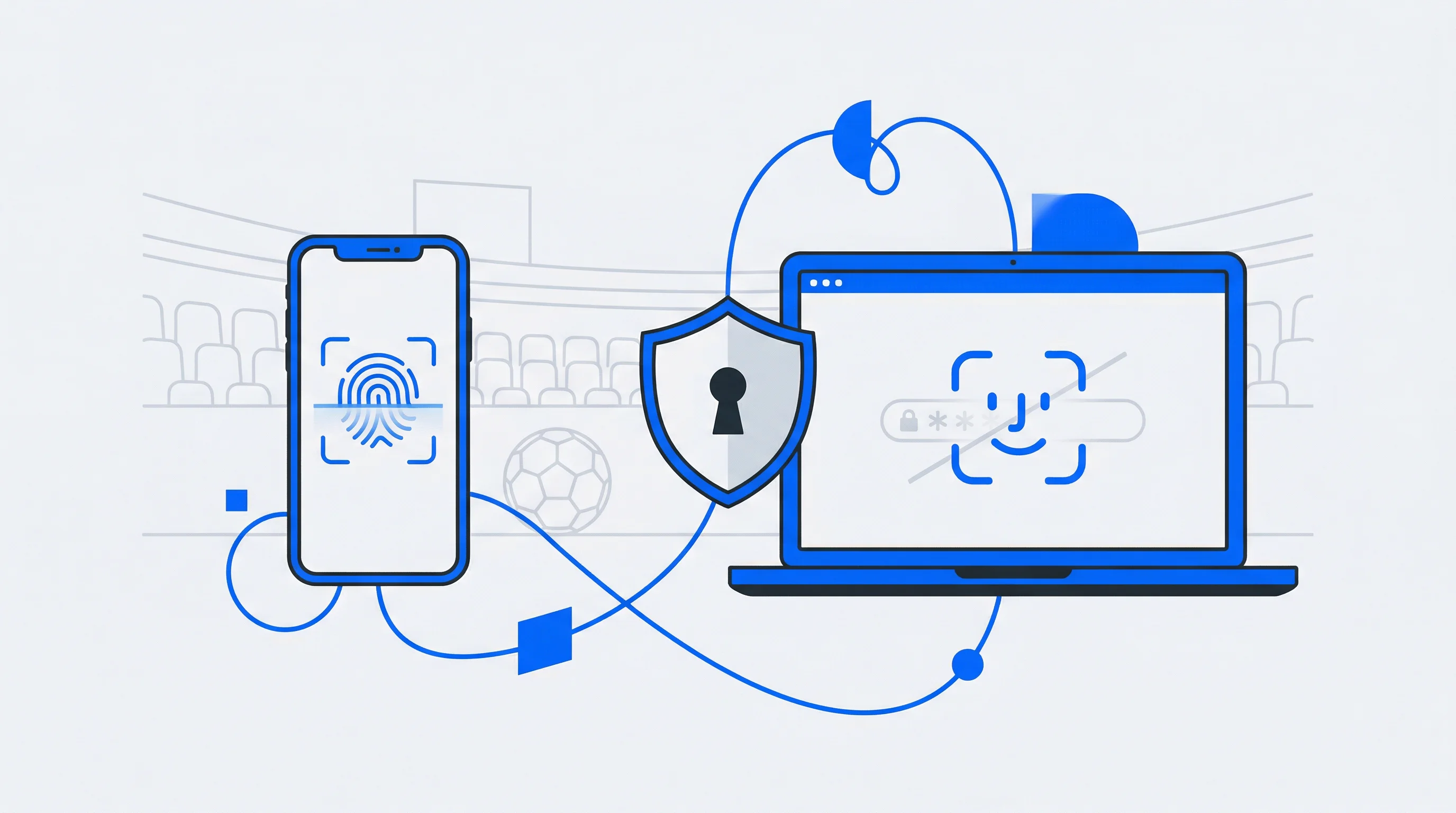
Passkey authentication replaces passwords with biometrics or a device PIN, letting sports club members sign in using a fingerprint, face scan, or screen lock instead of typing credentials. Built on FIDO2 and WebAuthn standards, passkeys are phishing-resistant by design—attackers can't steal what never leaves the member's device.
For clubs managing thousands of logins during ticket releases and match days, this shift eliminates password reset queues and reduces abandoned purchases. This guide walks through how passkeys work, why they matter for sports organizations, and the five steps to implement them across your member-facing systems.
What is passkey authentication
Passkey authentication is a passwordless login method that allows members to sign in using biometrics—like a fingerprint or facial recognition—or a device PIN instead of typing a password. The technology is built on FIDO2 and WebAuthn open standards, which means passkeys are phishing-resistant and secure by design. For sports clubs, this translates to faster logins during high-demand moments like ticket releases, and stronger protection for member accounts.
Here's how it works: when a member creates a passkey, their device generates two cryptographic keys. The private key stays on the device and never leaves. The public key gets stored by the club's authentication system. At sign-in, the device proves it holds the private key without ever transmitting it—so there's nothing for attackers to steal.
- Biometric verification: A fingerprint scan or face recognition confirms identity through the device's built-in sensors
- Device PIN: When biometrics aren't available, a locally stored PIN serves as the fallback
- Cryptographic security: Public-key cryptography ensures credentials can't be phished, intercepted, or reused on other sites
Why sports clubs need passwordless member login
Sports clubs deal with authentication challenges that most businesses don't face—an NCSC survey found 70% of sports organizations experienced cyber incidents in the previous year, compared to 32% of other businesses. On match days and during ticket releases, thousands of members try to log in at once. Forgotten passwords create bottlenecks—the FIDO Alliance found that 47% of consumers abandon purchases when they've forgotten their password.
Password resets also consume significant support resources. A single high-profile match can generate hundreds of reset requests, pulling staff away from other work. Meanwhile, traditional passwords remain vulnerable to phishing attacks—Verizon's 2025 DBIR found 88% of web application breaches involved stolen credentials—making fan databases attractive targets.
The member base at most clubs spans youth academy families to senior supporters, each with different comfort levels around technology. And members interact through multiple touchpoints—apps, websites, stadium Wi-Fi portals, partner platforms—often requiring separate logins for each.
How passkey authentication works for sports organizations
Understanding the technical foundation helps clubs evaluate vendors and communicate confidently with IT teams. The good news: passkeys rely on widely adopted standards that work across devices and browsers without locking you into proprietary technology.
WebAuthn and FIDO2 standards
WebAuthn (Web Authentication API) is the browser standard that enables passkey functionality. FIDO2 is the broader framework that includes WebAuthn along with device-level protocols. Together, they ensure passkeys work consistently across Chrome, Safari, Firefox, and Edge on all major operating systems.
Because these are open standards, your club isn't dependent on any single vendor. Any platform supporting FIDO2 can authenticate your members, which gives you flexibility when choosing identity providers.
Public key cryptography in member authentication
Each passkey consists of two mathematically linked keys. The private key never leaves the member's device—it's stored in a secure enclave that even the operating system can't access directly.
When a member signs in, their device uses the private key to sign a challenge from your authentication server. The server then verifies the signature using the stored public key. Even if attackers compromise your database, they only get public keys, which are useless for impersonation.
Benefits of passkeys for sports clubs and federations
The advantages go beyond security. For federations rolling out identity solutions across multiple clubs, passkeys provide a standardized authentication method that scales efficiently.
Phishing-resistant security for member data
Passkeys are bound to specific domains during creation. A passkey created for your club's official site simply won't work on a lookalike phishing page—the cryptographic verification fails automatically. This protection operates at the protocol level and requires no vigilance from members.
Faster sign-ins and higher ticket conversion rates
Members authenticate in seconds using a fingerprint or a glance at their phone. FIDO Alliance benchmarking shows passkeys achieve a 93% sign-in success rate compared to 63% for traditional methods. During high-demand ticket releases, this speed translates directly to completed purchases rather than abandoned carts.
Lower password reset costs and IT burden
Password resets disappear as a support category entirely. The staff time previously spent on reset requests becomes available for member engagement, technical improvements, or other priorities.
Stronger GDPR compliance with passwordless authentication
Passkeys align with data minimization principles under GDPR. Without password hashes to store, clubs reduce their data liability. Platforms hosted entirely within the EU—like Unidy—further strengthen compliance by keeping member data within European jurisdiction.
Five steps to implement passkey authentication for your club
Moving from concept to implementation follows a logical sequence. Each step builds on the previous one, reducing risk and building organizational confidence along the way.
1. Audit your current member authentication systems
Start by mapping every login point members encounter: ticketing portals, membership dashboards, mobile apps, stadium Wi-Fi, and partner integrations.
Document which systems support modern authentication standards like OpenID Connect (OIDC) or SAML.
- Current login methods in use (passwords, social login, SMS OTP)
- Number of separate login systems members encounter
- Existing Single Sign-On (SSO) infrastructure or lack thereof
- Password reset volume and support ticket frequency
This inventory reveals integration complexity and helps prioritize which systems to address first.
2. Select a passkey-ready Single Sign-On platform
A central SSO platform simplifies passkey deployment across all club services. Rather than implementing passkeys separately in each system, the SSO layer handles authentication and passes verified identity to connected applications.
| Criteria | What to look for |
|---|---|
| Standards support | FIDO2, WebAuthn, OpenID Connect, SAML |
| Integration depth | APIs, SDK, webhooks, pre-built connectors |
| Data hosting | EU-hosted for GDPR compliance |
| Branding | Customizable login screens matching club identity |
| User management | Central profile and consent cockpit |
Platforms like Unidy offer ready-to-go identity management with passkey support, branded user accounts, and extensive integration capabilities.
3. Launch an opt-in pilot with a member segment
Begin with a willing subset of members—season ticket holders or premium members who engage frequently with digital services work well. This group provides valuable feedback while limiting exposure if issues arise.
Communicate clearly that passkeys are optional during the pilot phase. Gather feedback on the registration flow, sign-in experience, and any device-specific challenges. Then use those insights to refine messaging and support resources before broader rollout.
4. Make passkeys the default login method
After a successful pilot, configure passkeys as the primary login option. Prompt existing members to create a passkey at their next sign-in, explaining the benefits in simple terms. Keep password login available as a temporary fallback.
The transition prompt is a critical touchpoint. Clear, encouraging language increases adoption rates. Some clubs offer a small incentive—like early access to ticket sales—to motivate early adopters.
5. Phase out passwords and legacy MFA gradually
Set a realistic timeline for deprecating passwords, typically several months after passkey adoption reaches a target threshold. Communicate the timeline clearly through email, app notifications, and website banners.
Provide support resources for members who need assistance. A brief video tutorial, FAQ page, and responsive support channel address most concerns.
How members sign up and sign in with passkeys
Understanding the member experience helps clubs communicate changes effectively and anticipate questions.
Creating a passkey during member registration
New members enter their email address and complete verification. Their device then prompts them to create a passkey using biometrics or PIN. The entire process takes seconds, and the passkey is stored securely in the device's credential manager.
Signing in with biometrics or device PIN
Returning members tap "Sign in," and their device prompts for biometric verification or PIN. Authentication completes almost instantly—no typing, no waiting for codes.
Managing passkeys across mobile and desktop
Passkeys sync across devices through platform ecosystems like iCloud Keychain or Google Password Manager. A member who creates a passkey on their iPhone can use it on their iPad or Mac automatically. Alternatively, members can register separate passkeys on each device they use.
How to handle device changes and account recovery
Device transitions and lost access represent the most common concerns about passkey adoption. Fortunately, established solutions address both scenarios.
Syncing passkeys when members get a new phone
Cloud-synced passkeys transfer automatically when members set up a new device with the same platform account (Apple ID or Google account). No action is required from the club—the passkey simply appears on the new device.
Recovery options when a member loses access
When a member loses all devices with registered passkeys, recovery flows restore access securely. Common approaches include email-based verification to register a new passkey, backup codes issued during initial setup, or identity verification through support channels.
A central identity platform manages recovery consistently across all club services, preventing fragmented experiences where members regain access to some systems but not others.
Common challenges when adopting passkeys for sports clubs
Anticipating objections helps clubs address concerns proactively.
Misconceptions about browser and device support
Passkey support is broader than many assume. All major browsers and operating systems work with passkeys:
- Apple devices: iOS 16+, macOS Ventura+, Safari
- Android devices: Android 9+ with Google Play Services
- Windows: Windows 10/11 with Windows Hello
- Browsers: Chrome, Safari, Firefox, Edge (current versions)
Transitioning existing members from passwords
Migrating an established member base requires patience and clear communication. Progressive enrollment works well: prompt passkey creation at login, send email campaigns explaining benefits, and offer support resources for those who need guidance.
Handling shared or family member accounts
Some households share accounts for family memberships. Passkeys accommodate this through individual passkeys per family member linked to one membership, or platform-level solutions for family account management.
How to measure passkey adoption success
Tracking the right metrics demonstrates ROI and identifies areas needing attention.
Tracking adoption rate and login completion
Monitor the percentage of active members with passkeys registered, login success rate, and average login completion time.
Monitoring support ticket volume
Password-related support requests represent a clear baseline. Track the reduction in reset requests after passkey rollout to quantify IT savings.
Measuring conversion rate improvements
Connect authentication improvements to business outcomes by tracking whether faster logins correlate with higher ticket purchase completion and membership renewal rates.
Why passkeys work best with a central identity platform
Passkeys solve authentication, but a central identity platform unifies passkey login with consent management, 360° member profiles, and data synchronization across CRMs, ticketing systems, and marketing tools.
For federations managing multiple clubs, a central platform enables consistent rollout and shared member identity across the league. Members authenticate once and access services across all affiliated clubs seamlessly.
- Unified member profiles: Aggregate data from ticketing, merchandise, and engagement into one identity
- Consent management: GDPR-compliant preference center tied to member login
- Cross-club federation: Single identity works across all league clubs
- Revenue activation: Enable premium memberships and ID-based campaigns from the same platform
Read more about identity management for sports organizations
What is the difference between passkeys and multi-factor authentication?
Passkeys combine device possession with biometric verification in a single step, replacing both the password and the second factor. Multi-factor authentication (MFA) adds a second step on top of a password, while passkeys eliminate passwords entirely.
Can members use passkeys on both the club app and website?
Yes, passkeys work across apps and websites on the same device. Cloud-synced passkeys also authenticate members across multiple devices linked to the same platform account.
How do passkeys work with shared family devices?
Each family member can register their own passkey on a shared device. At sign-in, the device prompts to select which passkey to use based on the biometric or PIN provided.
Do passkeys require the latest smartphone?
No, passkeys are supported on most smartphones released in recent years, including devices running iOS 16 or later and Android 9 or later with Google Play Services.
How long does passkey implementation take for a sports club?
Implementation timeline depends on existing infrastructure. Clubs using a passkey-ready SSO platform can launch an initial pilot within weeks and complete full rollout over a few months.
Can sports clubs keep passwords as a fallback login option?
Yes, most implementations maintain password login as a temporary fallback during the transition period, allowing members time to adopt passkeys before passwords are fully deprecated.
::
Newsletter Subscription Management Best Practices
A growing subscriber list means nothing if half the addresses bounce and the other half never open your emails. The real value of a newsletter lies not in its size but in how well you manage the people on it.
The rise of Passkeys as the next generation authentication method
For users, logging in to services and accounts online is part of everyday life. For a long time, this required traditional passwords, which are considered insecure and cumbersome. Passkeys are an alternative that simplifies many things and offers numerous advantages in everyday use for both users and organizations.