

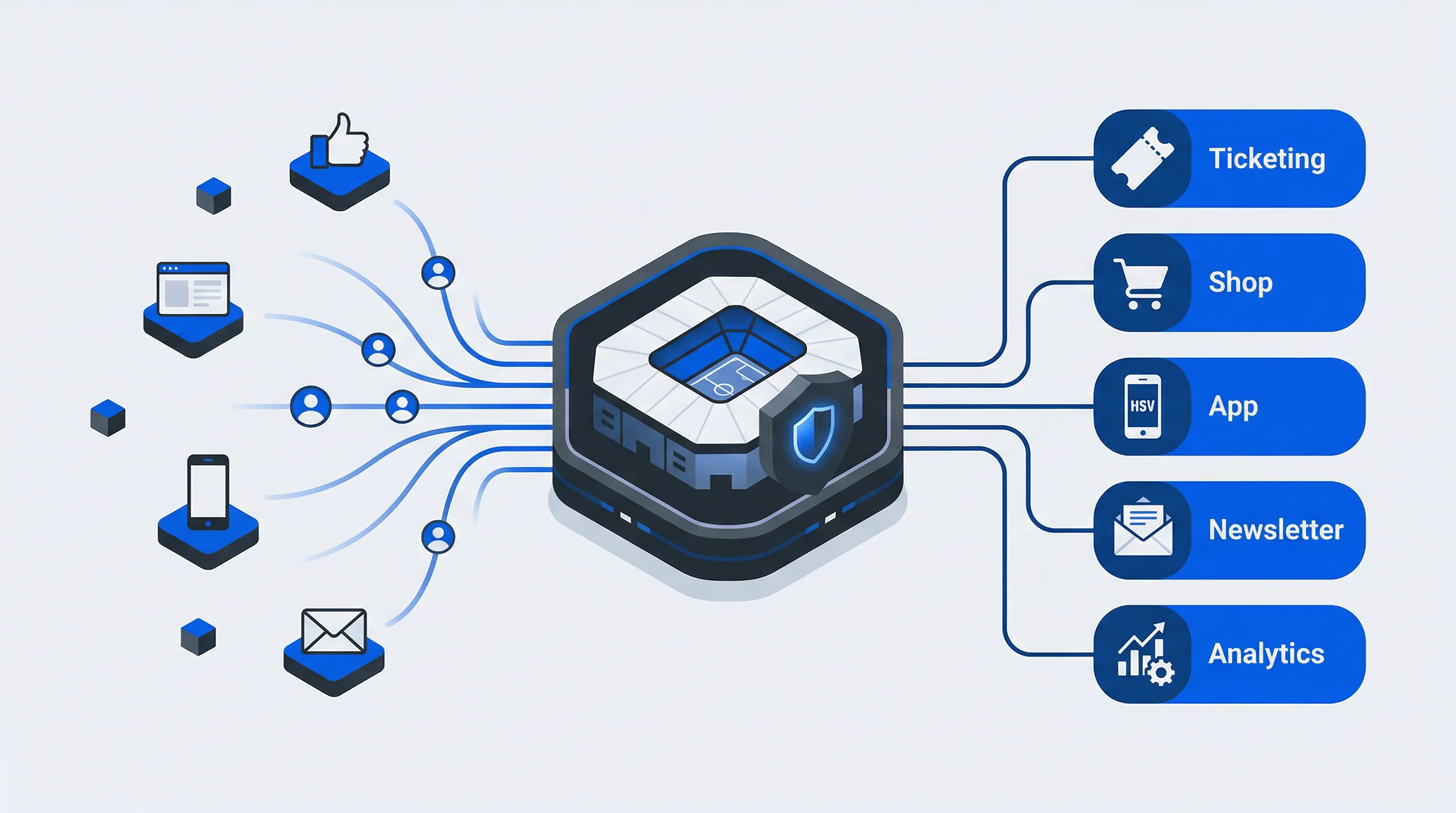
Hamburger SV (HSV) faced a challenge familiar to many major sports and entertainment organizations: massive digital reach without data ownership. With nearly 700,000 social media followers, the club had strong engagement, but the critical first-party fan data was locked away in silos and controlled by third-party platforms.
This paradox led to high operational costs due to tool sprawl, slow campaign launches, and revenue left on the table because services weren't connected for personalization.
The central challenge was clear: Transform reach into direct, activatable fan relationships.
The Solution: Centralized Identity with HSV.ID
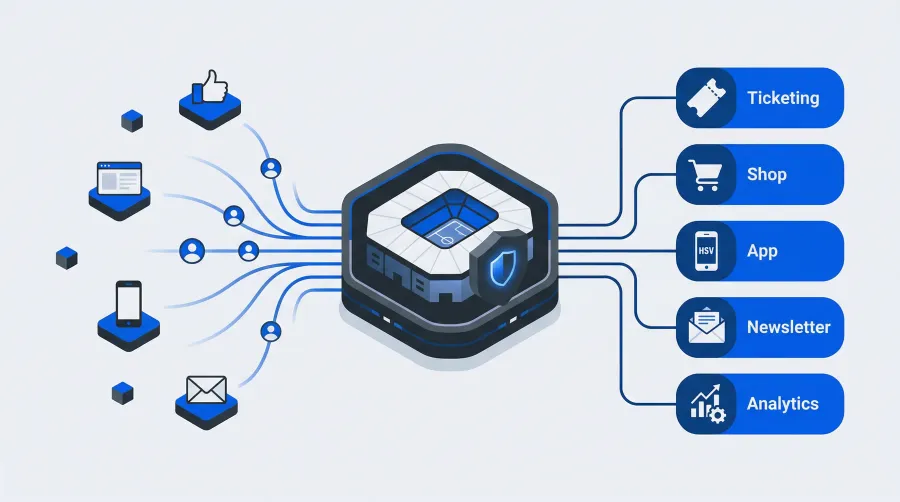
To overcome these hurdles, HSV partnered with Unidy to implement a solution based on centralized digital identity: HSV.ID.
Understanding Centralized Fan Identity Management
Centralized fan identity management creates a single, unified digital identity for each fan across all touchpoints and services. Instead of managing separate logins for ticketing, merchandise, newsletters, and apps, fans access everything through one verified identity.
For sports clubs, this approach transforms fragmented data silos into a comprehensive fan database. Every interaction—whether purchasing tickets, engaging with content, or participating in campaigns—contributes to a complete 360° fan profile that drives personalization and revenue opportunities. This is the same principle behind single sign-on for digital organizations: one identity, every service.
Building Owned Fan Data from Digital Reach
The key to converting social media followers into owned fan data lies in creating compelling activation journeys. HSV developed strategic touchpoints that guided followers from passive social engagement to active, identified participation in the club's digital ecosystem.
These activation strategies included exclusive content offers, match prediction games, early access to tickets, and member-only experiences—all requiring HSV.ID registration. Each touchpoint was designed to provide immediate value while capturing explicit consent and profile information, transforming anonymous reach into campaign-ready, GDPR-compliant fan data. This mirrors what zero-party data strategies deliver at scale: users share information willingly because they understand the value exchange.
HSV.ID became the single point of truth and the foundation for the club's owned audience strategy, featuring:
- Single Sign-On (SSO): One login connects all fan services—ticketing, shop, app, newsletter, and VIP areas—seamlessly, reducing drop-offs and increasing conversion.
- First- and Zero-Party Data: The system centralizes GDPR-compliant opt-ins and profiles, connecting this rich data to CRM and BI systems for precise targeting and segmentation.
- Activation Strategy: Journeys guide users into HSV.ID, converting followers into identified contacts with explicit consent, driving personalization for ticketing, the shop, and membership programs.
Measurable Impact: Results from 4.5 Years of Operation
The shift to a centralized fan identity delivered immediate and quantifiable results since going live in June 2021.
From Social Followers to Activatable Fan Profiles
The transformation from passive social media reach to activatable fan profiles required a systematic approach combining compelling content strategy with frictionless registration experiences. HSV created multiple conversion pathways that met fans at different stages of engagement.
High-engagement social content drove followers to exclusive offers requiring HSV.ID registration. Match-day experiences, behind-the-scenes content, and player interactions all became gateways for profile creation. The seamless single sign-on experience eliminated traditional registration friction, while personalized follow-up campaigns demonstrated immediate value from sharing profile information.
The results prove that consolidating identity management is the blueprint for digital sports success:
- 500,000+ Activatable Fan Profiles: The club built over half a million registered fans with verified contacts, securing direct reach without relying on opaque algorithms.
- 1.8 Million Granular Opt-ins: Fans provided an average of 3.6 consents per person, creating a campaign-ready and fully GDPR-compliant database.
- 70% Social-to-Owned Conversion: A massive portion of the club's social reach was successfully converted into identified, measurable, and activatable contacts.
- 12+ Integrated Services: Consolidating the digital ecosystem led to approximately 30% less IT effort through reduction of tool sprawl.
Seven out of ten social followers became identified, activatable contacts
"Consolidating identity management is the blueprint for digital sports success."
— HSV.ID, 4.5 years in production
Deep Dive: Sponsor Activation as a Win-Win-Win
The success case details a specific example of how HSV.ID monetizes the owned audience: the König Pilsener Prediction Game.
By integrating the prediction game within the HSV App via HSV.ID's OAuth, the club streamlined participation while activating over 20,000 profiles. This created a triple win:
- Sponsor: Gained qualified contacts, brand presence, and measurable performance.
- HSV: Acquired owned fan profiles with opt-ins and campaign-ready segmentation.
- Fans: Experienced seamless value and incentives without media breaks.
This model demonstrates how white-label identity infrastructure turns authentication into a monetization engine—sponsor activations become frictionless because identity is already established and consent already granted.
Ready to Build Your Own Fan Identity Platform?
The HSV story provides a crucial roadmap and blueprint for sports digitalization for any organization looking to move beyond third-party platform dependencies and build a valuable, direct relationship with its audience.
Want to learn how Unidy can help your organization achieve similar results?
How companies increase digital sales with Unidy
Collect - Increasing number of user profiles / Connect - Increase data fields and opt-ins per user / Convert - Increase revenue per user
What Is Keycloak? IAM and Single Sign-On Guide
Keycloak is an open source identity and access management solution that enables Single Sign-On across applications and services. Developed by Red Hat, it handles authentication, authorization, and user management through a centralized platform that supports industry-standard protocols like OpenID Connect and SAML.