

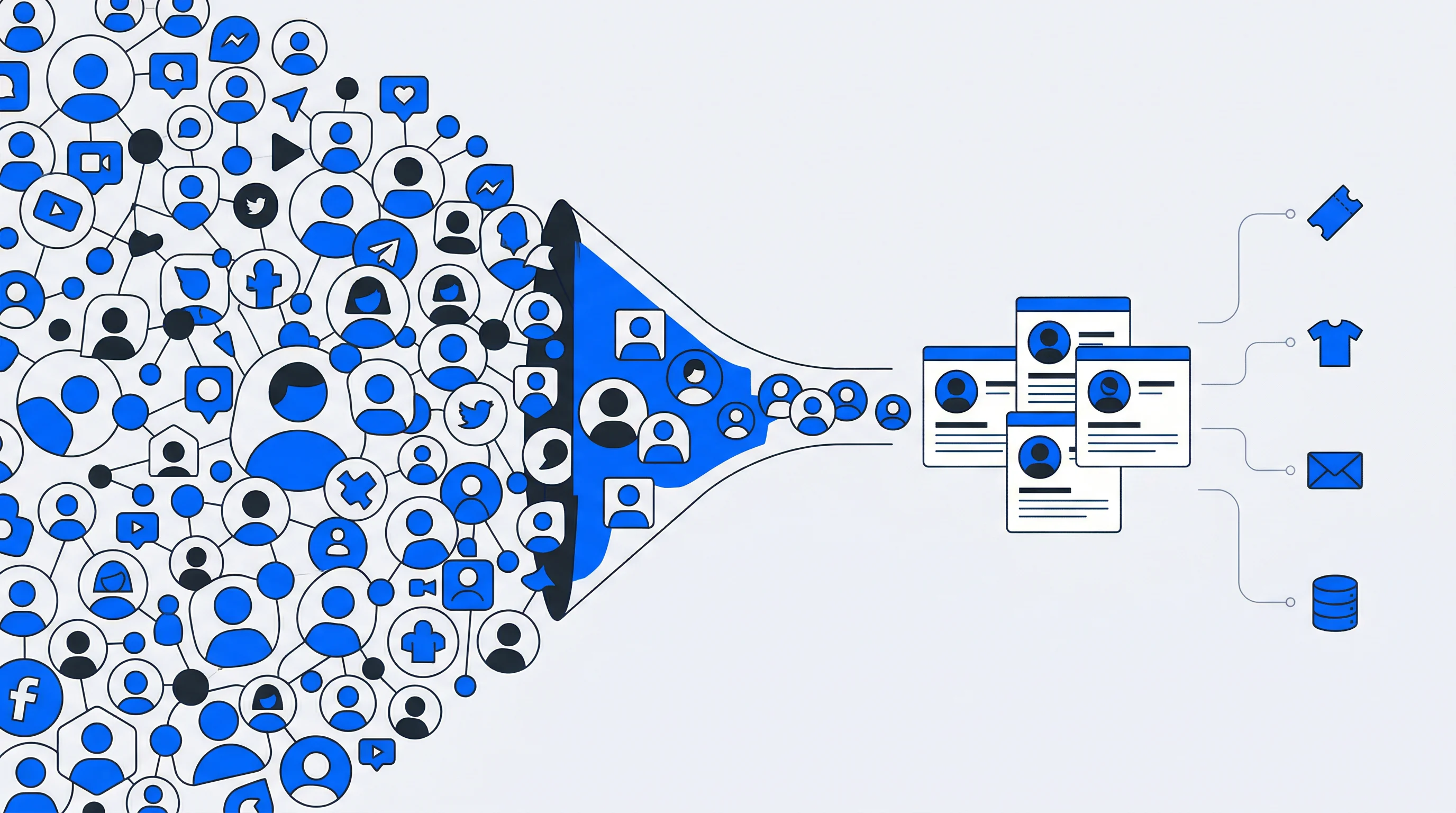
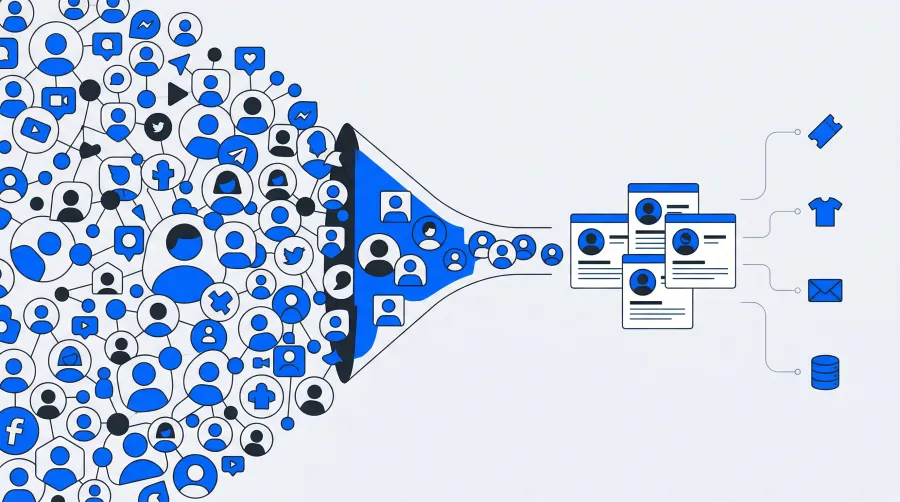
A typical Bundesliga club has between 2 and 5 million social media followers across Instagram, Facebook, TikTok, and X. Yet when you ask these same clubs how many fans they can actually contact directly, with consent, for marketing purposes—the number drops to a fraction. Often less than 100,000. Sometimes far less.
This is the social media monetization gap: the chasm between reach and ownership, between followers and fans you can actually activate.
And it's costing clubs millions in unrealized revenue every single year.
The Paradox: Massive Reach, Minimal Data Ownership
Here's a scenario that plays out across European football every week: A club posts about their new third kit on Instagram. The post reaches 500,000 people. Gets 50,000 likes. 2,000 comments. The marketing team celebrates the engagement.
But how many of those 500,000 people can the club email about the kit sale? How many can they retarget with a personalized offer? How many do they actually know anything about—their location, their purchase history, their ticket preferences?
The answer, in most cases, is close to zero.
This isn't a failure of the marketing team. It's a structural problem with how modern sports organizations have built their digital presence. They've invested heavily in building audiences on platforms they don't control, using data they don't own, reaching fans through algorithms they can't influence.
The result is what we call a "rented audience"—impressive on paper, but fundamentally fragile and commercially limited.
Defining the Monetization Gap
The social media monetization gap represents the difference between your total audience reach and the portion of that audience you can actually activate for commercial purposes. It's the vast disconnect between vanity metrics—followers, likes, shares—and business metrics: email subscribers, identified customers, convertible prospects.
This gap exists because social media platforms are designed to maximize engagement on their platforms, not to help organizations build direct relationships with their audiences. Every interaction stays within the platform's ecosystem. Every data point belongs to the platform, not to you.
For sports organizations, media companies, and publishers, this creates a fundamental business vulnerability: impressive audience numbers that don't translate into controllable marketing channels, trackable conversions, or sustainable revenue streams independent of platform algorithms and advertising costs.
What Clubs Actually "Own" on Social Media
Let's be clear about what social media platforms provide to sports organizations:
What you get:
- A broadcast channel to post content
- Aggregated engagement metrics
- The ability to pay for additional reach
What you don't get:
- Email addresses of your followers
- Names, locations, or demographics
- Purchase history or intent signals
- Permission to contact fans directly
- Guaranteed reach (organic reach is typically 2–5% of followers)
- Data portability if you leave the platform
When a club "has" 3 million Instagram followers, what they actually have is 3 million people who clicked a button once. The relationship—and all the valuable data about it—belongs to Instagram.
Social Reach vs. Owned Audience: Key Distinctions
Understanding the fundamental difference between social reach and owned audience is crucial for building sustainable digital revenue.
Social Reach represents the potential number of people who might see your content through social media platforms—followers, plus anyone reached through shares, hashtags, or algorithmic recommendations. Social reach is:
- Platform-dependent and algorithm-controlled
- Difficult to predict or guarantee
- Not directly contactable outside the platform
- Anonymous to your organization
Owned Audience consists of individuals who have directly provided their contact information and consent to your organization—email subscribers, registered users, app downloads, newsletter sign-ups. Owned audience is:
- Platform-independent and directly accessible
- Controllable and predictable in terms of reach
- Identifiable and trackable across touchpoints
- Enrichable with behavioral and preference data
The critical insight: social reach might get you visibility, but owned audience generates revenue. Organizations that focus only on growing follower counts without converting that reach into owned relationships are building their business on rented land.
The Revenue Leakage
This ownership gap creates tangible business problems:
Sponsorship activation limitations: Sponsors increasingly demand measurable fan activation, not just logo placement. Without owned fan data, clubs struggle to demonstrate ROI or create targeted sponsor campaigns.
Merchandise blind spots: A club might know that jersey sales increased after a social post, but they can't identify which of their millions of followers actually bought—or which ones almost did but need a follow-up offer.
Ticket personalization gaps: Season ticket renewal campaigns blast the same message to everyone because clubs don't know which fans attend every match versus which ones need convincing.
Content monetization constraints: Premium content requires knowing who your most engaged fans are. Social platforms keep that insight to themselves.
One industry estimate suggests that clubs with strong owned fan databases generate 3–5x more revenue per fan than those relying primarily on social reach. The gap compounds over time.
Every owned profile is worth multiples of a social follower — and the gap compounds
Case Study: How Hamburger SV Solved the Monetization Gap
Hamburger SV faced this exact challenge. With nearly 700,000 social media followers, the club had significant digital reach. But that reach wasn't translating into data ownership or commercial activation.
The problem wasn't just about social media. Fan data was scattered across 12+ different systems: the ticket shop had one set of records, the merchandise store another, the membership database a third, the stadium WiFi yet another. Fans might appear in multiple systems with different email addresses, or in some systems but not others.
The club had fragments of fan relationships everywhere, but no unified picture of who their fans actually were.
The Transformation: Building HSV.ID
Rather than trying to force fans to create yet another account, HSV took a different approach. They built HSV.ID as a central fan identity layer that connected all existing touchpoints.
The key insight: fans don't want to manage multiple accounts. They want one identity that works everywhere—for tickets, merchandise, content, memberships, stadium access, everything.
HSV.ID became that single identity. It didn't replace the ticketing system or the merchandise platform. It connected them, creating one fan profile that enriched itself every time a fan interacted with any HSV digital property.
The Results After 4.5 Years
- 500,000+ activatable fan profiles built from previously fragmented data
- 1.8 million marketing opt-ins collected with proper consent
- Unified 360-degree view of fans across all touchpoints
- Sponsor activation at scale with targeted, measurable campaigns
Key Success Factors
Single identity, not single system: They didn't try to replace all existing tools. They added an identity layer that made existing systems work together.
Value exchange at every touchpoint: Fans got something for creating their HSV.ID—exclusive content, early access, personalized offers. The identity wasn't a barrier; it was a benefit.
Progressive data collection: Registration started simple (just email). Additional data came through ongoing interactions, not lengthy forms.
Integration with existing investments: The ticketing system stayed. The shop platform stayed. They just became connected through a shared fan identity.
The Follower-to-Profile Conversion Framework
Based on what we've seen work across dozens of sports organizations, here's a framework for converting social reach into owned fan profiles.
Step 1: Create Identity Anchors
Identity anchors are moments where fans have a reason to identify themselves. The most effective anchors combine genuine value with natural data capture:
- Ticket purchases: The clearest transaction moment. Every ticket buyer should become a known fan.
- Merchandise transactions: Shop purchases, both online and in-stadium.
- Content subscriptions: Premium content, newsletters, match highlights access.
- App downloads: Mobile apps provide persistent identity and behavioral data.
- Stadium WiFi: Free WiFi in exchange for identification captures in-person attendance.
- Competition entries: Giveaways and contests drive opt-in.
Step 2: Build Value Exchanges
Fans won't create an account just because you ask. Effective value exchanges include exclusive access, early ticket booking, personalization, faster checkout, and membership benefits. The value must be obvious and immediate. "Create an account" fails. "Get 10% off your first order and early access to new kits" succeeds.
Step 3: Progressive Profiling
Don't ask for everything upfront. Start with minimal friction (email only) and build the profile over time:
- At registration: Email, maybe name
- At first purchase: Billing details, delivery address
- Through preferences: Favorite player, preferred content types
- Through behavior: Which emails they open, what content they consume, which events they attend
A profile that builds over 10 interactions is more complete and accurate than a long form that 80% of people abandon.
Step 4: Activate Across Channels
- Personalized email campaigns: Segmented by interests, purchase history, engagement level
- Sponsor partner activations: Targeted offers from sponsors to relevant fan segments
- Retargeting: Using first-party data rather than third-party cookies
- Loyalty programs: Points and rewards tied to identity
- Event personalization: In-stadium experiences tailored to known fans
Monetization Strategies for Publishers and Sports Organizations
Converting social media audiences into owned profiles enables multiple revenue streams that simply aren't possible with follower-only relationships:
Premium Content & Subscriptions: Once you know who your audience is, you can offer tiered content experiences. Publishers can segment casual readers from dedicated subscribers. Sports clubs can provide member-only match analysis, player interviews, or behind-the-scenes content.
Targeted Sponsorship Activations: Brands pay premium rates when they can reach specific, verified audience segments rather than broad, anonymous social reach. Organizations can activate sponsors through personalized offers to fans who actually attend matches or buy merchandise.
E-commerce Integration: Known audience members become qualified prospects for merchandise, tickets, and partner products. Sports clubs can suggest merchandise based on past purchases or event attendance patterns.
Event & Experience Monetization: Sports organizations can offer exclusive fan experiences, meet-and-greets, or premium hospitality packages to known supporters.
Data-Driven Advertising: First-party audience data enables more effective advertising campaigns with higher conversion rates and lower acquisition costs—reducing dependency on expensive social media advertising by building direct marketing channels to confirmed audiences.
The key insight: every owned profile represents multiple monetization opportunities over time, while social media followers represent only potential reach without revenue certainty.
Common Mistakes to Avoid
Mistake 1: Building Another Data Silo. The solution: implement an identity layer that connects existing systems rather than replacing them. The identity platform becomes the connective tissue; specialized tools (ticketing, e-commerce, CRM) continue doing what they do best.
Mistake 2: Asking for Too Much Too Soon. Long registration forms kill conversion. The solution: start with email only. Build the profile through ongoing interaction. Each additional piece of data should come with its own value exchange.
Mistake 3: Ignoring Existing Data. Many clubs have years of customer data spread across old systems. The solution: migration, matching, and enrichment. Bring existing data into the new identity framework.
Mistake 4: Treating Identity as an IT Project. The solution: marketing-led implementation with IT enablement. The business defines what fan profiles should enable. Technology makes it possible. Neither succeeds without the other.
The Technology Requirements
Essential capabilities to look for in an identity platform:
- Single Sign-On across all properties: One login for ticketing, shop, content, app, and any other digital touchpoint
- Ticketing system integration: Bidirectional sync with platforms like Eventim, vivenu, or in-house systems
- E-commerce integration: Connected with Shopify, custom shops, or merchandise platforms
- CRM/CDP synchronization: Data flowing to and from marketing automation and customer data platforms
- GDPR-compliant consent management: Proper opt-ins with audit trails and easy preference management
- White-label branding: The fan identity should feel like the club, not the technology vendor
- Progressive profiling: Built-in support for gradual data collection
A platform that can't connect to your existing touchpoints won't solve the fragmentation problem—it will add to it.
Getting Started: A 90-Day Roadmap
Days 1–30: Foundation. Audit the current data landscape. Identify highest-value integration priorities (usually ticketing and e-commerce). Define fan identity requirements with input from marketing, commercial, and IT. Select and contract with an identity platform.
Days 31–60: Implementation. Deploy the identity platform infrastructure. Build integrations with priority touchpoints. Migrate and match existing fan data. Configure branded registration and profile experiences. Test SSO flows across all connected systems.
Days 61–90: Activation. Soft launch to internal team and test users. Refine based on early feedback. Public launch with promotional campaign. Begin progressive profiling strategies. Establish measurement framework and initial benchmarks.
This timeline assumes a focused effort. Complex organizations or extensive legacy systems may need longer, but momentum matters—a 90-day target keeps the project from drifting.
The Window of Opportunity
Three trends are making owned fan data more valuable than ever:
Third-party cookie deprecation: As browser tracking becomes restricted, organizations that built first-party data assets will maintain targeting capabilities while others lose them.
Platform algorithm changes: Social media reach is increasingly pay-to-play. Organic visibility continues declining. Owned channels become more valuable by comparison.
Sponsor expectations: Brands want measurable fan activation, not just impressions. Clubs that can deliver targeted, trackable campaigns command premium sponsorship rates.
Clubs that build owned fan databases now will compound that advantage over years. Those that wait will find themselves further behind, with fewer tools available to catch up.
The social media monetization gap is real, but it's not permanent. Every club that has millions of followers has the raw material to build hundreds of thousands of owned fan relationships. The question is whether they'll make the investment now, or watch that potential continue slipping through their fingers.
Ready to Convert Your Followers into Fan Profiles?
Unidy helps sports clubs transform fragmented fan data into unified, activatable profiles. With 40+ clubs already using our platform—including HSV, FC St. Pauli, 1. FC Köln, and Hamburg Towers—we've built the integrations and workflows that make fan identity management practical.
Download the full HSV case study to see the detailed transformation story, or book a demo to discuss your club's specific situation.
Explore our 100+ integrations to see how Unidy connects with your existing ticketing, e-commerce, and marketing systems.
Social Login vs. SSO: Key Differences Explained
Social login and Single Sign-On (SSO) both promise to eliminate password fatigue—reported at high levels by 39% of Americans—but they solve different problems for different audiences. Social login lets consumers authenticate with existing accounts from Google or Facebook, while SSO gives organizations a unified identity layer across multiple applications.
The End of Third-Party Cookies
What it Means and How to Respond - Moving Away from Opaque Collection and Use of Consumer Data Towards a Decision-Oriented, Transparent, and Privacy-Friendly Future.